What Are Towel Ladders?
Towel Ladders are freestanding or wall-mounted rails designed to hold and display towels. Their open, runged shape lets fabric hang visibly, rather than hiding it inside a cupboard. You may see them in bathrooms, beside a bathtub, or near a bedroom dressing area. Some are made from wood; others use metal with a painted or polished finish. The right choice depends on available space, the room’s moisture levels, and how many towels you need to hang.
Interior designer Nate Berkus has said, “Your home should tell the story of who you are, and be a collection of what you love.” That principle can guide the choice of a towel ladder: its material and finish should suit the room, not merely fill an empty corner. A warm wooden frame can soften pale tile. A slim black metal design can echo dark taps or cabinet handles. Small detail. Real difference. Still, a ladder is not automatically practical. A narrow model may hold fewer towels than expected, and a freestanding frame needs stable, level flooring. Check its dimensions before buying, and consider whether wet fabric will dry well in the intended spot. These useful fixtures combine storage with display, though they can also look cluttered when overloaded. In this guide, we’ll explore how Towel Ladders work, what styles and materials are available, and which practical details deserve a closer look. The choice is simple, sometimes. The room is not always.
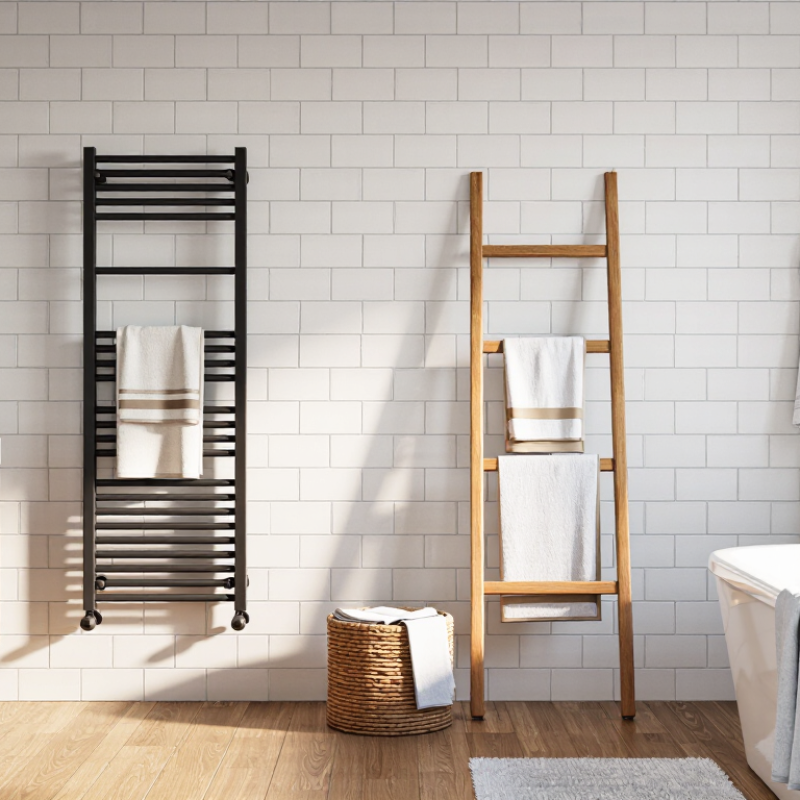
What Is a Towel Ladder? Its Structure and Everyday Function
A towel ladder is a freestanding or wall-mounted rack with two vertical rails and several horizontal bars. The open frame lets towels hang visibly instead of folding them inside a cabinet. It can sit beside a shower, near a vanity, or against an unused wall. Check the feet and fixings before loading it; a tall, narrow ladder can wobble if its base is uneven.
Its everyday job is simple: keep towels within reach and spread them out after use. Draping a towel over one bar leaves more fabric exposed to air than bunching it on a hook, though drying still depends on airflow and room humidity. The U.S. Environmental Protection Agency’s moisture guidance recommends keeping indoor humidity below 60%, ideally between 30% and 50%.
A towel ladder cannot control humidity. Use a bathroom exhaust fan when moisture builds up, and leave space between towels.
Small detail. A damp towel folded over itself may stay damp longer. Choose a finish suited to bathroom conditions, and measure the available space before buying; a ladder that blocks a door or walkway is not useful.
I sometimes expect it to dry towels like a heated appliance. It won’t.
How Rung Spacing Accommodates Common 27 × 54-Inch Bath Towels
What Are Towel Ladders?
A towel ladder is a freestanding or wall-mounted frame with horizontal rungs for hanging towels. For a common 27 × 54-inch bath towel, folding the 54-inch length in half over a rung creates two hanging sections, each about 27 inches long. That drop matters: close-set towels can overlap and dry slowly. A practical starting point is 10–12 inches between rungs, measured vertically, with towels hung on alternate rungs when quicker drying matters. Treat this as design guidance, not a universal standard. ASTM D5433-15(2021), a performance specification for woven towels, covers properties such as absorbency and dimensional change; it does not prescribe ladder spacing. I’d test the fit with a damp towel, since showroom spacing can feel cramped in a real bathroom.
Tips: Measure your towel after laundering. Check the usable gap, not just the rung centers. Small detail, big difference. If towels touch, use fewer rungs at once or spread them wider; a ladder’s capacity is not always its drying capacity.
Material Options: 304 Stainless Steel Contains About 18% Chromium
What Are Towel Ladders?
A towel ladder is a wall-mounted or freestanding rail with horizontal bars for hanging towels. In damp bathrooms, 304 stainless steel is a popular material because it combines strength with useful corrosion resistance. ASTM A240/A240M lists Type 304 at 18.0–20.0% chromium and 8.0–10.5% nickel. So “about 18% chromium” describes the lower end of its specified range, not every finished product’s exact composition.
Chromium helps form a thin passive layer on the steel surface. It can renew when exposed to oxygen, helping resist everyday moisture. The Nickel Institute’s technical guidance on stainless steel explains that resistance depends on both the alloy and its environment. Soap residue, cleaning chemicals, and trapped water can still leave marks. Stainless steel is not stain-proof. A ladder near a shower may need more frequent care than one in a dry guest bathroom. That detail is easy to overlook.
Tips: Check the grade marking or product specification before buying. Wipe the bars dry after heavy splashes, and use a soft cloth for routine cleaning. If a surface develops spots, reconsider the cleaner before assuming the steel itself has failed.
What Are Towel Ladders? - Material Options: 304 Stainless Steel Contains About 18% Chromium
| Material | Typical Composition or Finish | Corrosion Resistance | Practical Considerations for a Towel Ladder |
| 304 stainless steel | Typically 18–20% chromium and 8–10.5% nickel; chromium content is commonly described as about 18%. | Good resistance to corrosion in ordinary indoor environments, including many bathrooms. | A common choice for indoor towel ladders. Keep it clean and dry when possible; prolonged exposure to chlorides, such as salt or some cleaning products, can cause staining or corrosion. |
| 316 stainless steel | Typically 16–18% chromium, 10–14% nickel, and 2–3% molybdenum. | Generally offers better resistance to chloride-related corrosion than 304. | Can be useful in coastal settings or other more corrosive environments. It is often selected where greater corrosion resistance is a priority. |
| 201 stainless steel | Typically 16–18% chromium, 3.5–5.5% nickel, and 5.5–7.5% manganese. | Corrosion resistance depends on the environment and is generally lower than that of 304 in demanding conditions. | May be used in indoor products where conditions are less corrosive. Regular cleaning and avoiding harsh or chloride-containing cleaners can help maintain its appearance. |
| Aluminum | Aluminum alloy; composition varies by alloy and product. | Forms a protective oxide layer, but performance depends on the alloy, surface finish, and exposure conditions. | Lightweight and easy to handle. Check the stated load capacity and finish, especially if the ladder will be used in a humid area. |
| Coated carbon steel | Steel protected by a coating such as powder coating or plating. | Protection depends on the coating; scratches or damaged areas may expose the steel underneath. | Often offers a range of colors and finishes. Inspect the coating periodically and avoid abrasive cleaning that could damage it. |
Note: Stainless-steel composition ranges are typical specification ranges and can vary by applicable standard and product grade. Actual durability also depends on fabrication, finish, installation, cleaning, and exposure conditions.
Where Towel Ladders Are Used in Bathrooms and Other Rooms
In a bathroom, a towel ladder offers open storage without taking up much floor space. It can stand near a shower or bathtub, where damp towels need room to dry. Leave enough clearance for towels to hang freely, rather than bunching them against a wall. A narrow bathroom may suit a wall-mounted ladder; a leaning style needs a stable, level floor and enough space behind it. Check the fixing points and weight limits before hanging heavy bath sheets. Small details matter.
Outside the bathroom, towel ladders can hold throws in a living room or scarves and light blankets in a bedroom. In a laundry area, they provide a handy place for items that should air-dry. They can also display folded textiles, though the open rungs collect dust more readily than a closed cupboard. A ladder can look tidy in a photo yet feel awkward in a busy room, especially if people brush past it. Not perfect. Consider how often the space is used, whether the ladder could tip, and whether its finish suits a room that may get humid. A little planning helps it serve as useful storage, not just decoration.
Towel Ladders: Accessible Bathroom Planning Dimensions
Towel ladders are commonly placed in bathrooms, bedrooms, and laundry rooms. When planning a bathroom layout, keep accessible floor space and reach in mind. The chart shows ADA reference dimensions in inches; these are accessibility dimensions, not required towel-ladder measurements.
Source: 2010 ADA Standards for Accessible Design, Sections 305.3 and 308.2.1.
How to Choose a Ladder: Check Dimensions, Stability, and Load Rating
What Are Towel Ladders?
How to Choose a Ladder: Check Dimensions, Stability, and Load Rating
A towel ladder is a vertical rack with horizontal bars for hanging towels. Before buying, measure the wall or floor space, including room for towels to hang freely. A narrow bathroom may suit a wall-leaning model, while a freestanding design needs clear floor space. Check the product’s full height and width, not just its appearance in a photo. Small detail, big difference.
Stability matters when wet towels pull unevenly on the bars. Look for secure joints, non-slip feet, and clear instructions for wall placement or anchoring. Check the stated load rating and whether it applies to the whole ladder or each bar. ANSI A14.2 classifies portable metal climbing ladders from 200 to 375 pounds by duty rating; those figures do not certify towel ladders. Never climb a towel rack. I would still inspect the joints in person when possible, since polished photos can hide a wobble.
Tips: Compare the ladder’s rating with the combined weight of your towels and anything else you plan to hang. Place it on a level surface, then test gently before loading it. If it rocks, shifts, or leans more after towels are added, choose another setup.