
A Skylight Window can turn a dim hallway into a bright passage or bring morning light across a kitchen table. Yet the right choice depends on more than appearance. Roof pitch, room size, climate, ventilation needs, and access for cleaning all matter. A fixed unit may suit a quiet bedroom, while an operable model can release warm, stale air. Details count.
VELUX founder Villum Kann Rasmussen is often credited with the principle, “One experiment is worth a thousand expert opinions.” It is a useful reminder to assess real daylight, not just a product photo. Notice where sunlight falls at different hours. Check how rain, glare, and heat may affect the room. A beautiful installation can still disappoint.
This guide introduces ten common skylight types, from fixed and vented designs to tubular and roof-window options. Each offers different benefits, constraints, and installation demands. Some work best in compact spaces; others frame broad roof views. The list is a starting point, not a universal ranking. A roof’s structure can change what is practical, and that deserves careful review. Small details matter. Before choosing, compare glazing, flashing, shading, and maintenance access with a qualified installer. The best Skylight Window is the one that suits the house—not simply the one that looks striking in a showroom.
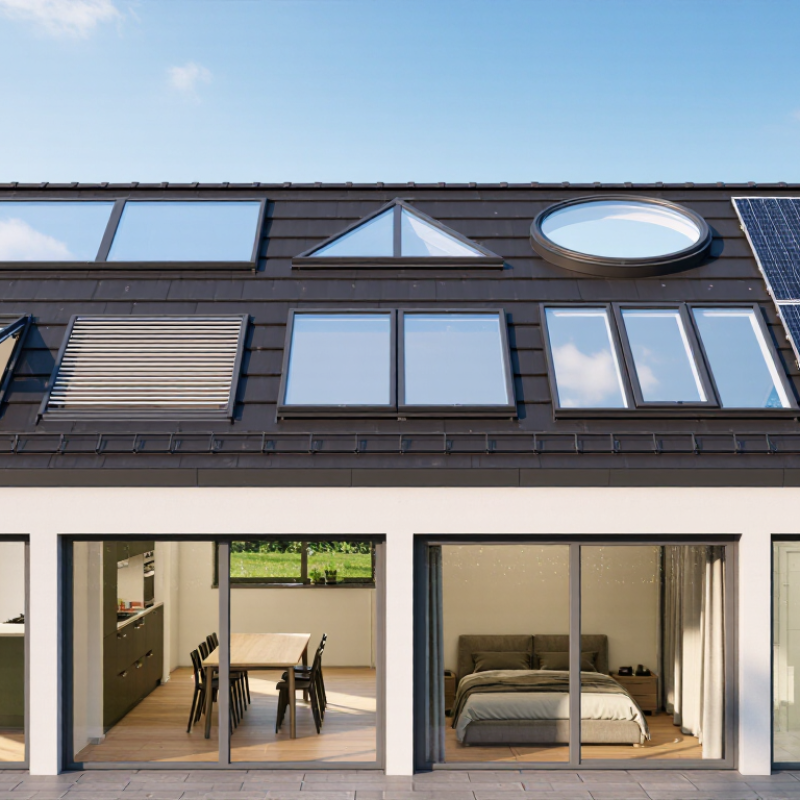
A skylight is defined by three choices: how it opens, what its glazing does, and where it sits on the roof. Fixed units bring daylight without ventilation; venting models open by hand or motor to release warm air. Tubular skylights route daylight through a reflective shaft, useful where rafters leave little room. Roof placement matters, too: curb-mounted units sit above the roof surface, while deck-mounted units sit closer to it. A south-facing opening may admit more winter sun, but can also create summer glare.
Glazing changes comfort. Double panes, low-emissivity coatings, and gas-filled spaces can reduce heat transfer, but ratings matter more than labels alone. The U.S. Energy Information Administration’s 2020 Residential Energy Consumption Survey reports that space heating used about 42% of household energy. That is not a skylight-performance figure, but it highlights why heat loss deserves attention. Compare NFRC-listed U-factor and solar heat gain coefficient (SHGC) for the local climate. A lower U-factor generally means less heat transfer; the best SHGC depends on sun exposure.
Tips: Match the opening to the room: a venting skylight may help a steamy bathroom, while a fixed unit suits a high ceiling. Check roof pitch, flashing details, and shade before ordering. Small mismeasurements matter. And daylight can be uneven; a bright patch on the floor is not the same as comfortable room lighting.
| Skylight Type | Opening Style | Common Glazing | Typical Roof Placement | Best Suited For | Practical Consideration |
|---|---|---|---|---|---|
| Fixed Skylight | Non-opening; permanently sealed | Insulating glass, often double-glazed; glass may include a low-emissivity coating | Pitched or flat roofs, depending on the unit and flashing system | Bringing daylight into rooms that do not need added roof-level ventilation | Usually simpler than an operable skylight, but it does not provide ventilation and still needs careful flashing and installation. |
| Manual Venting Skylight | Opens with a hand crank, pole, or other manual control | Typically insulating glass; some models use impact-resistant plastic glazing | Within reach on a roof slope or positioned for operation with an extension pole | Bathrooms, kitchens, and other spaces where occasional natural ventilation is useful | Opening the unit can release warm air, but the sash should be closed during rain unless the unit is designed to remain open in wet weather. |
| Electric Venting Skylight | Motorized opening, usually controlled by a wall switch or remote | Commonly double-glazed glass; glazing options depend on the model | Pitched or flat roofs with access to the required electrical supply | High ceilings or locations where manual operation is inconvenient | May include rain sensors, but sensor features vary; electrical installation and compatible flashing are important. |
| Solar-Powered Venting Skylight | Motorized opening powered by an integrated solar panel | Usually insulating glass; available glazing features vary by product | Roof areas with suitable sunlight exposure for the solar panel | Rooms needing convenient ventilation without a new wired power connection | Performance depends on the unit’s design and charging conditions; check operation, backup provisions, and local climate suitability. |
| Tubular Daylighting Device | Generally fixed; a roof-mounted collector directs daylight through a reflective tube | Roof domes are commonly clear or diffusing plastic; a ceiling diffuser spreads light indoors | Small roof openings connected to interior ceilings by a reflective tube | Hallways, closets, and compact spaces where a conventional skylight may not fit | It brings in daylight but typically offers little or no view of the sky and is not a substitute for an opening window. |
| Curb-Mounted Skylight | May be fixed or operable; mounted on a raised frame, or curb | Glass or plastic glazing, depending on the skylight unit | Common on low-slope roofs; also used on some pitched roofs | Roof layouts that use a raised curb to support the skylight and its flashing | The curb and flashing must be correctly sized and integrated with the roof; a curb-mounted unit is a mounting style, not necessarily an opening type. |
| Deck-Mounted Skylight | May be fixed or operable; installed close to the roof deck | Usually insulating glass, with available coatings and pane configurations varying by unit | Most often on sloped roofs where the unit is designed for direct deck installation | Homes needing a relatively low-profile skylight installation | Roof pitch limits and flashing requirements are product-specific; the unit must be compatible with the roof covering. |
| Flat-Glass Skylight | Usually fixed, though operable versions are available | Flat insulating glass; safety-glazing requirements depend on location and applicable codes | Pitched roofs and certain flat-roof systems using a suitable frame or curb | Spaces where a clear, relatively unobstructed view of the sky is desired | Glass configuration, slope, drainage, and safety requirements should be selected for the specific roof and installation. |
| Dome Skylight | Usually fixed; some designs can be opened for ventilation | Often acrylic or polycarbonate; some designs use multiple layers for insulation | Commonly installed on flat or low-slope roofs, often over a curb | Low-slope roofs and spaces where a raised, curved profile is suitable | Plastic glazing can be lighter than glass, but UV resistance, impact performance, and long-term weathering vary by material and product. |
| Pyramid Skylight | Generally fixed; constructed with multiple sloping glazed panels | Typically glass panels; frame and glazing specifications vary | Often placed over a central room, atrium, or other large opening on a flat or low-slope roof | Large spaces where a prominent architectural feature and broad overhead daylight are wanted | Requires careful structural design, drainage planning, and weatherproof detailing; it is usually a more involved installation than a small standard unit. |
Note: These categories can overlap. For example, a skylight can be both electric-venting and deck-mounted, or fixed and curb-mounted. Glazing choices, roof-pitch limits, and code requirements vary by product and location.