
Print Logo

Who Are the Top Automated Palletizing Robot Suppliers in China?

China has become an important sourcing market for robotic palletizing equipment, but “top supplier” depends on the job. A beverage plant stacking mixed cartons needs different tooling from a warehouse handling uniform bags. An Automated Palletizing Robot should match the product, pallet pattern, available floor space, and required production rate. The details show up on the line: gripper changes, pallet alignment, safety fencing, and recovery after a carton shifts. Small things matter.

This introduction compares Chinese suppliers through practical criteria rather than a ranking alone. It considers robot payload and reach, end-of-arm tooling, control-system integration, installation support, spare-parts access, and experience with similar applications. A polished product page is useful, but it cannot prove how a system performs across a full shift. Ask for application references, cycle-time assumptions, and a clear scope of commissioning. Then check whether the proposed layout leaves room for operators and maintenance. Some details may still be difficult to verify before a site visit. That is worth saying plainly. The best choice is not always the largest manufacturer or the lowest quotation; it is the supplier that can explain its limits, document the solution, and support the equipment after delivery.
Who Are the Top Automated Palletizing Robot Suppliers in China?

What Automated Palletizing Robots Are and How They Work

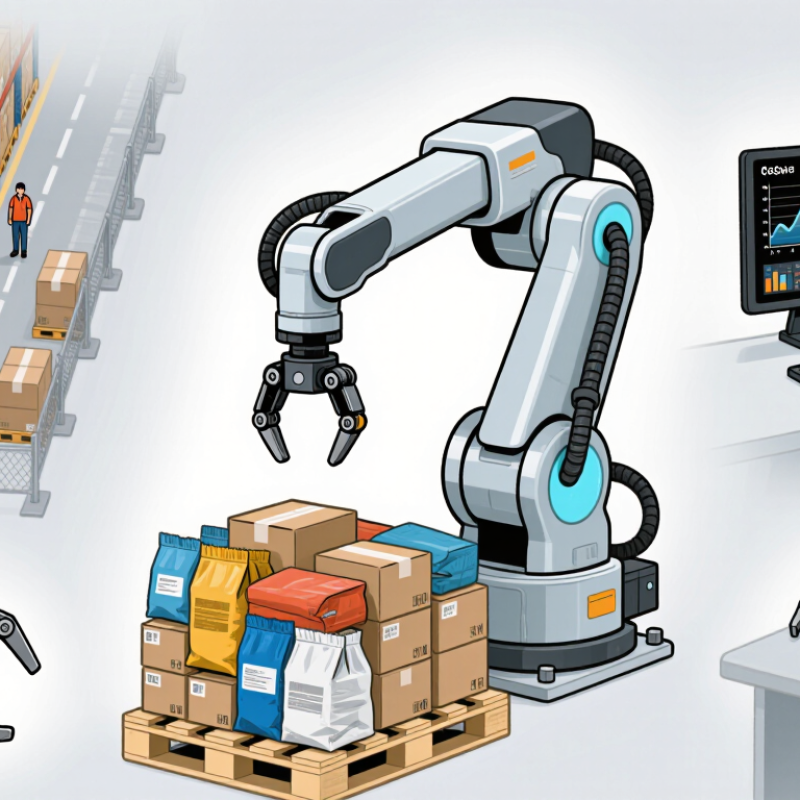
An automated palletizing robot transfers cartons, bags, or cases from a conveyor onto a pallet in a planned arrangement. A typical cell combines a robotic arm, end-of-arm gripper, conveyor, sensors, safety equipment, and control software. The gripper may use vacuum cups, clamps, or forks, depending on package weight and shape. Sensors help the system detect product position and confirm each pick. The robot then places items in programmed layers, often alternating their orientation to improve stack stability.

The workflow is simple to describe, but real packages can be awkward. A crushed carton or shifting bag may disrupt an otherwise precise pattern. The International Federation of Robotics reported 541,302 industrial robot installations worldwide in 2023, in its World Robotics 2024 report. That figure covers industrial robots broadly, not palletizing systems alone, but it shows the scale of industrial automation. In a palletizing cell, controllers coordinate the robot with conveyor speed and upstream production. Operators can adjust layer patterns, pallet dimensions, and product recipes when orders change. Small details matter. A gripper suited to rigid boxes may handle flexible sacks poorly, so testing actual products remains important.

Key Technologies Used in Automated Palletizing Systems

Automated palletizing systems combine robot arms, vision sensors, motion control, and end-of-arm tools. Each part has a practical job. A 3D camera can measure carton position and detect uneven rows before a robot lifts a load. The controller then adjusts the arm’s path and placement angle. Small corrections matter.

Grip technology depends on the package. Vacuum cups suit many sealed cartons, while mechanical clamps can handle products with less stable surfaces. Some systems switch tools between product types. A well-designed gripper should hold firmly without crushing a box corner. That sounds simple, but dusty surfaces and changing carton sizes can disrupt suction.

Pallet-pattern software arranges cases to balance stability, weight, and available space. Conveyor sensors track incoming loads, while safety scanners monitor access around the robot cell. Operators also need clear alarms and useful production data. Fancy dashboards are not enough. They must help staff find a real fault quickly. Integration can still be awkward, especially when older conveyors use different control signals. Careful testing with actual cartons often reveals issues that simulations miss. That step takes time, yet skipping it can lead to unstable stacks or frequent stoppages.

How China’s Palletizing Robot Supplier Market Is Structured

China’s palletizing robot supplier market is layered, not a simple list of arm manufacturers. At the core are robot makers supplying arms, controllers, and motion software. System integrators then combine these components with grippers, conveyors, safety equipment, and pallet patterns. Some suppliers focus on complete end-of-line cells; others specialize in integration for food, chemicals, building materials, or logistics. The distinction matters. A strong robot arm alone cannot compensate for poor line balancing or difficult package handling.

The International Federation of Robotics reported 276,288 industrial robot installations in China in 2023, about 51% of global installations. This figure covers industrial robots broadly, not palletizing systems specifically. It indicates a deep manufacturing and service ecosystem, but it does not identify the best palletizing supplier. Buyers should compare demonstrated payload, cycle time, changeover needs, and local maintenance response. Ask to test the actual carton or bag, not just a sample load. Details matter. Supplier claims can look precise, yet site conditions often expose gaps in floor space, product variation, or upstream flow. One uncomfortable point: published performance figures are difficult to compare unless the test conditions match.

Leading Automated Palletizing Robot Suppliers in China

Leading Automated Palletizing Robot Suppliers in China

Leading automated palletizing robot suppliers in China should be judged by more than advertised speed. Look for teams that can explain payload, reach, cycle time, and pallet patterns using your actual cartons. A 20-kilogram case and a slippery 8-kilogram bag need different gripping strategies. Ask suppliers to test mixed product sizes, uneven infeed spacing, and the exact pallet dimensions used at your site. Request a cycle-time estimate that includes picking, travel, placement, and layer changes. A polished demonstration is useful, but it cannot reveal every production issue.

Tips: Bring sample products and a real pallet specification to the discussion. Check guarding, operator access, changeover steps, spare-part availability, and local service response. Ask for a written acceptance test. Small details matter.

A capable supplier should also explain how the robot connects with conveyors, sensors, and existing controls. Review the proposed layout for forklift access and safe maintenance space. Ask who handles installation, training, and troubleshooting after commissioning. References from similar industries can help, though one factory’s results may not transfer directly to yours. Be cautious when promised performance has no stated test conditions. Even a well-designed cell may need adjustment once cartons arrive with real-world variation. That part is easy to overlook.

Who Are the Top Automated Palletizing Robot Suppliers in China? - Leading Automated Palletizing Robot Suppliers in China

Supplier-neutral overview: the table compares common palletizing system types available from suppliers in China. Figures are indicative industry ranges, not specifications or rankings for any particular supplier.

System type Typical payload / reach Typical applications Key supplier capabilities to check
Articulated industrial robot Model-dependent; industrial palletizing models commonly cover payloads from tens to several hundred kilograms, with reach often around 1.6–3.2 m. Cases, bags, cartons, and mixed-SKU palletizing on production lines. Payload at the required reach, cycle-time validation, gripper design, safety guarding, and pallet-pattern software.
Collaborative robot palletizer Commonly suited to lighter loads, with model-dependent payloads typically in the single-digit to low-tens-of-kilograms range; reach is generally shorter than that of large industrial robots. Lower-throughput lines, flexible cells, and facilities with frequent product changeovers. Risk assessment, required safeguarding, actual cycle time, end-of-arm tooling, and suitability for the case size and weight.
Cartesian or gantry palletizer Payload and working area are configuration-specific; there is no single standard range across designs. Large working areas, defined pallet patterns, or applications requiring linear-axis movement. Frame stiffness, travel envelope, floor space, load handling, and access for maintenance.
Conventional layer palletizer Capacity depends on the line layout, product, and layer-forming mechanism; compare using a tested line-rate proposal. High-volume lines that palletize complete layers of consistent products. Layer formation, changeover time, pallet and slip-sheet handling, line-rate guarantees, and footprint.
Integrated palletizing cell Specified for the complete application rather than by robot payload alone. Turnkey projects involving conveyors, product handling, pallet dispensing, guarding, and controls. System integration responsibility, interface list, acceptance testing, documentation, training, and local service support.

Before comparing suppliers, provide the product dimensions and weight, required line rate, pallet pattern, available floor space, and shift schedule. Confirm proposed performance against a representative product and request a written scope of supply, safety documentation, warranty terms, and service plan.

How to Compare Suppliers and Choose a Suitable System

A useful comparison starts with your actual packing line, not a supplier’s fastest cycle-time claim. Record carton sizes, weights, pallet dimensions, and the number of patterns needed. Small details matter. A robot handling light, uniform boxes may struggle with soft cartons or mixed products. Ask suppliers to test your own cartons and show a full pallet, including the bottom layer and corners. Watch for shifting, crushed edges, and inconsistent cycle times.

Look beyond the robot arm. Check the gripper, controls, guarding, and how the cell connects to conveyors or production software. Ask how operators change pallet patterns and restart the system after a jam. Simple recovery matters. Request a layout drawing and a clear list of required site utilities. References from facilities with similar products and shift schedules are more useful than a polished demonstration. Still, one visit cannot reveal every maintenance issue.

Compare total operating needs, not only purchase prices. Ask what commissioning, operator training, spare parts, and service response times include. Get expected changeover times in writing, and clarify how performance is measured. Visit an installed system if possible; notice whether operators can reach routine service points without awkward workarounds. Real floors are messy. A tidy demo may hide small delays, and suppliers may not predict every production change. That uncertainty is worth discussing openly.