
Print Logo

Top 10 Metal Film Resistor Manufacturers in China?

Choosing a Metal Film Resistor manufacturer involves more than comparing prices or browsing a polished product page. Engineers and purchasing teams need dependable resistance values, stable performance, and clear documentation. A resistor may look small on a circuit board, yet tolerance, temperature coefficient, and long-term drift can affect the whole design.

This guide introduces ten manufacturers in China and outlines practical points for comparing them. These include product range, stated specifications, quality-control practices, customization options, and communication during sampling. Buyers should check datasheets and request current test records rather than relying on broad claims. For example, confirm the resistance range, tolerance, rated power, and operating temperature for the exact part number. Details matter.

A ranked list can be useful, but it is not a universal verdict. The right supplier depends on the application, order volume, qualification needs, and delivery expectations. Public information may also be incomplete or change over time, so independent verification remains important. A sample can reveal issues that a catalog cannot, such as lead finish, packaging, or consistency between batches. No shortcut here. The following overview is intended as a starting point for informed supplier research, not a substitute for technical review or direct factory assessment.
Top 10 Metal Film Resistor Manufacturers in China?

What Defines a Metal Film Resistor and Its Key Features?

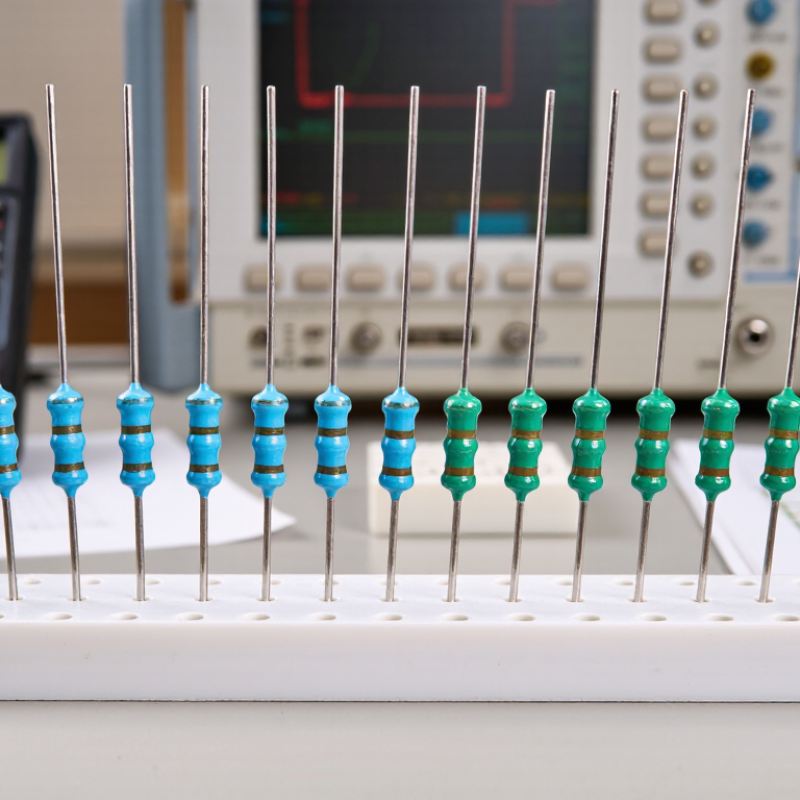
A metal film resistor uses a thin resistive alloy layer deposited on an insulating ceramic core. A spiral cut in the film sets the resistance value; protective coating and metal end caps help the component withstand handling and heat. The construction supports precise resistance and generally low noise. Small, but consequential. Compared with carbon-film types, metal-film parts often offer tighter tolerances and a lower temperature coefficient, though exact performance depends on the design and rating.

Check the datasheet, not just the label. Tolerance describes how far actual resistance may differ from its stated value, while temperature coefficient indicates how resistance shifts as temperature changes. For example, a circuit exposed to warming near a power component may need a lower temperature coefficient to keep readings stable. IEC 60115-1 provides general requirements and test methods for fixed resistors, making it a useful technical reference. A 2023 MarketsandMarkets resistor-market report estimated the market at USD 5.7 billion and projected USD 7.3 billion by 2028. That figure covers resistor types broadly, not metal-film parts alone. One easy mistake: treating a headline market estimate as proof of a specific resistor’s quality. Test conditions matter, and I still find that detail overlooked.

How China's Metal Film Resistor Industry Has Developed

China’s metal film resistor industry has grown alongside its electronics manufacturing base. In 2023, the Ministry of Industry and Information Technology reported that China’s electronic information manufacturing sector generated about RMB 15.1 trillion in operating revenue. This broad category includes many products, not resistors alone. Still, it helps explain the scale of the supplier ecosystem around them.

Production has moved beyond basic resistor assembly. Manufacturers increasingly use automated film deposition, laser trimming, and resistance testing to improve consistency. On a factory line, a tiny adjustment to a ceramic core can affect tolerance and long-term stability. The details matter. Higher demand for compact electronics and vehicle control systems has also encouraged suppliers to offer more precise components. However, public industry statistics rarely separate metal film resistors from other electronic components. That makes market-size claims difficult to verify. It is a real gap.

China’s development is not simply a story of rising output. Buyers now ask about temperature drift, noise, batch traceability, and performance under repeated thermal stress. These requirements push process control forward, though smaller producers may not upgrade at the same pace. MIIT’s sector-wide figures show scale, not uniform capability. A careful supplier comparison should therefore examine test methods and tolerance data, rather than relying on production volume alone.

What Factors Matter When Comparing Chinese Manufacturers?

When comparing Chinese metal film resistor manufacturers, look beyond the quoted resistance value. Check tolerance, temperature coefficient, rated power, operating-temperature range, and coating type. These details affect performance in compact circuits and equipment exposed to heat. Ask whether test results cover the finished resistor, not only incoming materials. Small details matter.

Production consistency deserves equal attention. Request sample data and quality records, then compare measurements across several pieces or batches. Check whether the manufacturer can explain traceability, inspection methods, and how it handles out-of-spec results. Clear technical answers are useful. Slow or vague replies may signal gaps in support, though they are not proof of poor quality. A datasheet rarely shows every production variation, so a sample evaluation can reveal differences that paperwork misses.

Tips: Test real samples under your expected load and temperature. Confirm packaging, lead time, and change-notification practices in writing. Ask for evidence, but allow time to verify it; supplier comparisons can remain imperfect when test conditions differ.

Top 10 Metal Film Resistor Manufacturers in China? What Factors Matter When Comparing Suppliers?

Suggested buyer evaluation weights (100 points total). These are an illustrative decision framework, not audited scores or a market ranking of manufacturers.

Compare suppliers using verified documentation and sample testing. Check resistance tolerance and temperature coefficient, production consistency, lot traceability, relevant certifications, delivery capability, engineering support, and total cost.

Which Companies Are Among China's Top Metal Film Resistor Manufacturers?

China’s leading metal film resistor manufacturers generally fall into three groups: specialist resistor producers, broad passive-component makers, and contract factories serving equipment designers. Their strengths differ. Specialist firms may offer tighter resistance tolerances and low temperature coefficients, while larger component makers often provide wider product ranges and steadier production capacity. Contract manufacturers can adapt lead spacing, packaging, or labeling for a specific assembly.

Look beyond catalog claims. Ask for current datasheets, tolerance and temperature-coefficient options, operating-temperature limits, and inspection records. For a small axial resistor, details such as coating quality and straight, evenly spaced leads can affect automated assembly. Request samples from the intended production batch, then compare measured resistance with the published specification. Details matter.

A dependable supplier should explain how it controls incoming materials, process variation, and lot traceability. Check whether its quality documents match the exact part number, not just a general factory certificate. A stated delivery capacity is useful, but confirm it against your forecast and required packaging. A ranking can mislead. I would treat any “top ten” list as a starting point, since public information may not reveal recent yield, service quality, or changes in production. That takes time.

Top 10 Metal Film Resistor Manufacturers in China? - Which Companies Are Among China's Top Metal Film Resistor Manufacturers?

Supplier evaluation checklist: the table summarizes commonly available metal film resistor specifications and verification points. These are indicative industry ranges, not specifications attributed to individual manufacturers or a verified company ranking. Always confirm the exact product datasheet.

No. Evaluation Dimension Indicative Product Data What to Verify with a Supplier
1 Resistance Range Common series cover values from a few ohms to several megohms; the available range depends on the series and package. Confirm standard values, custom-value availability, and resistance limits for the requested part number.
2 Resistance Tolerance Common options include ±1% and ±5%; precision series may offer tighter tolerances such as ±0.1% or ±0.25%. Check which tolerances are stocked and whether tighter options apply across the full resistance range.
3 Temperature Coefficient of Resistance (TCR) Product options commonly span approximately ±5 to ±100 ppm/°C, depending on construction and series. Review the specified TCR, measurement conditions, and resistance-value restrictions in the datasheet.
4 Rated Power Axial metal film parts are available in multiple ratings, often from about 0.125 W to a few watts; rating depends on body size and ambient conditions. Check the derating curve, mounting conditions, and maximum power at the intended ambient temperature.
5 Operating Temperature Many general-purpose series specify ranges around −55°C to +155°C, but the limits are product-specific. Confirm the operating range and any power derating or resistance-change limits over temperature.
6 Maximum Working Voltage The limit is determined by the part’s datasheet and may be lower than the value calculated from rated power and resistance. Check both the maximum working voltage and overload voltage; use the lower applicable design limit.
7 Stability and Reliability Resistance drift is normally specified as a limit after defined endurance, humidity, or temperature tests; there is no single universal value. Request the test conditions, allowable resistance change, and applicable qualification or inspection records.
8 Package and Construction Metal film resistors are offered in forms such as axial leaded parts and surface-mount chip parts; dimensions vary by series. Match package dimensions, termination style, mounting method, and the required PCB footprint.
9 Compliance Documentation RoHS and REACH status is specific to the product and documentation revision. Obtain current declarations and confirm they cover the exact part number and production location.
10 Automotive Qualification AEC-Q200 qualification applies only to specifically qualified component series; it should not be assumed for all metal film resistors. For automotive use, verify the exact series qualification, revision, and supporting reliability documentation.

Where Are Metal Film Resistors Used, and What Trends Shape Demand?

Metal film resistors are used where predictable resistance, low noise, and close tolerance matter. They appear in sensor interfaces, laboratory instruments, industrial controllers, and communication equipment. In a temperature-measurement circuit, for example, a stable resistor helps keep a small sensor signal usable. Automotive electronics also rely on resistors in monitoring and control circuits. They are not glamorous components. They are often the quiet parts that keep readings consistent.

Electrification and expanding electronics production are shaping demand. The International Energy Agency’s Global EV Outlook 2024 reported nearly 14 million electric car sales in 2023, about 18% of new car sales. More vehicles need electronic sensing and control, though this does not mean every circuit uses metal film parts. WSTS forecast the global semiconductor market would grow 19% in 2024, reaching $627.6 billion. That signals broader electronics activity, not a direct resistor-sales forecast. Still, the direction is useful. Designers increasingly balance compact layouts with accuracy, thermal stability, and dependable sourcing. Small details matter. A resistor may occupy little board space, yet its tolerance can affect a measurement chain. Growth figures do not tell the whole story: cost, operating temperature, and circuit design still determine the right component.