
A Salt Block Hydraulic Press must deliver steady pressure, repeatable cycles, and blocks that hold their shape after release. For buyers, the details are practical: rated force, working-table dimensions, mold compatibility, hydraulic controls, and access to spare parts. A large tonnage figure alone does not guarantee a suitable machine.
Demand context matters, but broad forecasts should not be mistaken for press sales data. The OECD-FAO Agricultural Outlook 2024–2033 projects global meat production to rise by 12% by 2033, compared with the 2021–2023 base period. This points to continuing activity across livestock supply chains, where mineral blocks are one of several feeding inputs. China’s National Bureau of Statistics reported that manufacturing value added grew 5.0% in 2023, offering useful context for the country’s industrial base—not proof of any individual supplier’s quality.
Details matter. This guide compares ten Chinese manufacturers through equipment range, technical transparency, customization, quality controls, and after-sales support. Where public specifications are limited, that limitation deserves attention; a polished catalog cannot replace a verified test or a clear service commitment. Buyers should request drawings, cycle-time information, and references for comparable block sizes before placing an order. No ranking fits every factory. The right choice depends on the material, output target, and maintenance capacity at the actual production site.
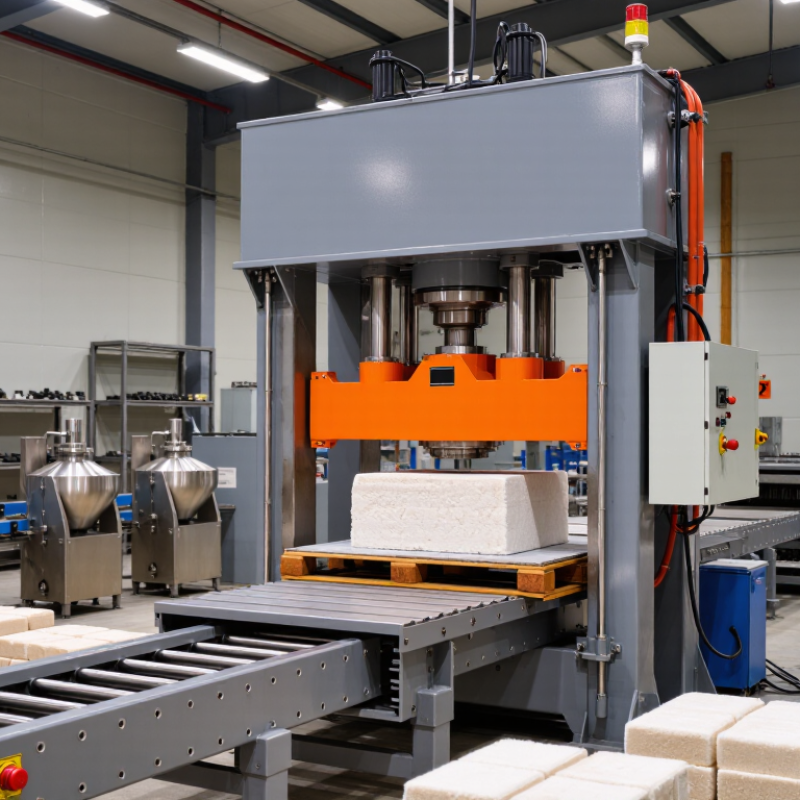
A salt block hydraulic press turns measured salt crystals into dense, handleable blocks through controlled feeding, compression, and ejection. Operators typically screen the feed, manage moisture, fill a steel die, then apply pressure for a set dwell time. Too much moisture can cause sticking; uneven granules can leave weak corners. Small details matter. USGS Mineral Commodity Summaries 2024 estimated U.S. salt production at about 42 million metric tons in 2023, reflecting the scale of the raw-material supply—not the volume used for pressed blocks.
Presses rated from 100 to 500 tons serve different block sizes and production rates. A 100-ton unit may suit smaller dies and modest output, while larger presses can support wider molds or multiple cavities. Yet rated tonnage alone is a poor buying guide. Die area, target density, cycle time, and ejection force also shape results. A test run with the actual salt blend can reveal cracking or spring-back before a line is specified.
Typical applications include livestock mineral blocks and compacted salt products for industrial handling. Livestock formulations may include other minerals, so the recipe and die must match the intended block. ISO 16092-3:2017 addresses safety requirements for hydraulic presses; it does not prescribe a universal capacity for salt-block production. There is a catch: higher pressure does not automatically mean better blocks. Teams should record moisture, fill weight, pressure, and cycle time, then inspect edges and breakage. Some variation remains, and it deserves attention.
This is a manufacturer-neutral buyer’s comparison guide, not a verified ranking of companies. Press capacities and configurations vary by machine; confirm the rated force, tooling, and finished-block requirements directly with each supplier.
| No. | Comparison Dimension | What to Check | Process or Application Relevance |
|---|---|---|---|
| 1 | Rated press capacity | Confirm the rated force in metric tonne-force (tf) and its equivalent in kilonewtons. The 100–500 tf range is approximately 981–4,903 kN. | Required force depends on the material, mold area, block dimensions, and target density. Rated tonnage alone does not establish production capacity. |
| 2 | Feed material and preparation | Ask about acceptable salt particle size, feed consistency, moisture considerations, and whether pre-processing is needed. | Consistent feed helps support repeatable filling and compaction. Suitability should be confirmed using the buyer’s actual salt material. |
| 3 | Pressing sequence | Check how the machine handles mold filling, compression, any programmed dwell, pressure release, and ejection. | These are common stages in a hydraulic compaction cycle; the exact sequence and cycle settings depend on the machine and product. |
| 4 | Hydraulic system and force control | Review pressure adjustment, gauges or sensors, cylinder specifications, and overload protection. | Hydraulic pressure acting on the cylinder area generates pressing force. Ask how force and cycle settings are monitored and adjusted. |
| 5 | Frame and platen design | Compare the frame layout, working opening, platen dimensions, and stated operating limits. | The frame and platen must suit the mold and withstand the specified working load; design details are model-specific. |
| 6 | Mold and block dimensions | Specify the required block shape, dimensions, mass, and any surface or edge requirements; confirm mold material and replacement arrangements. | Tooling determines the product geometry. A press’s maximum force does not by itself confirm that a particular mold or block size is suitable. |
| 7 | Ejection and handling | Check the ejection method, access for mold changes, and options for manual or automated block removal. | Ejection and handling arrangements affect operator workflow and integration with downstream collection or packaging equipment. |
| 8 | Controls and operator safety | Review the control interface, operating modes, emergency stop, guarding, and safety documentation supplied with the machine. | Controls and safeguards should match the installation, operating procedure, and applicable workplace safety requirements. |
| 9 | Potential product applications | Discuss the intended product and its end-use requirements before selecting the press and mold. | Salt compaction equipment may be configured for products such as water-softener salt tablets or livestock salt/mineral blocks; suitability depends on the material and product specification. |
| 10 | Testing, documentation, and service | Request a material trial where practical, a written specification, operating and maintenance manuals, spare-parts information, and service terms. | Testing with the intended feed and mold can help assess whether the proposed configuration meets the buyer’s product and production requirements. |