
Print Logo

How to Choose Hydraulic Pile Driving Rigs in Southeast Asia?

Choosing a Hydraulic Pile Driving Rig in Southeast Asia means matching equipment to real ground conditions, not just comparing hammer ratings. A rig working beside a congested Jakarta road faces different demands from one driving piles across a muddy Mekong Delta site. Soil layers, groundwater, access, transport limits, and local service support all shape the right choice. Small details matter. A narrow gate can rule out a wide crawler rig before the first pile arrives.

Hydraulic impact hammers offer controlled energy and useful adjustment, but performance depends on the whole setup. Check pile type, diameter, length, required penetration, and the rig’s working reach. Ask suppliers for documented capacity data and service references from comparable regional projects. Confirm spare-part availability, operator training, and how quickly technicians can reach the site. A high-capacity machine is not automatically the best fit. It may consume more fuel, need difficult transport arrangements, or sit idle while waiting for support.

A verified local expert can make this decision more grounded. Insert a named Southeast Asian piling specialist’s confirmed quotation here before publication; an invented attribution would undermine trust. The useful question is practical: what has the rig driven in soil like yours, under conditions like yours? Compare that evidence with a site investigation and a realistic project schedule. Then leave room for uncertainty. Ground conditions can change sharply over a short distance, and early assumptions sometimes prove wrong. The best choice is capable, serviceable, and suited to the site—not simply the largest machine available.
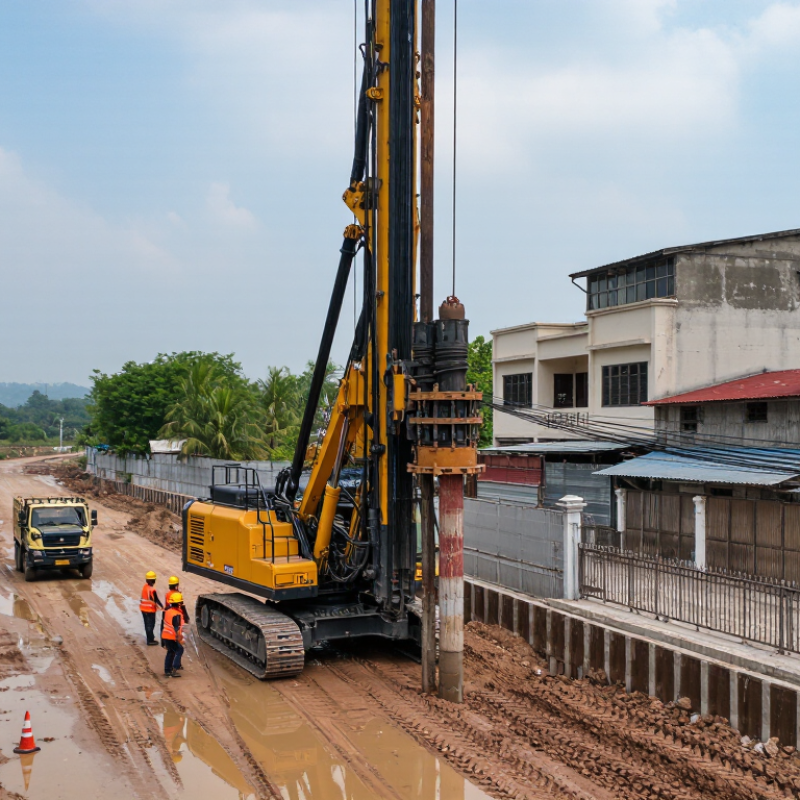
How to Choose Hydraulic Pile Driving Rigs in Southeast Asia?

Define the Project Scope and Pile Installation Requirements

Define the project before comparing hydraulic pile driving rigs. List the pile material, diameter, length, target capacity, and estimated pile count. Include the installation method and any required driving records. A 300-millimeter precast pile and a large steel pipe pile place very different demands on the rig.

Small details matter. In parts of Southeast Asia, soft alluvial layers, high groundwater, and changing ground conditions can occur within one site. Review available borehole logs and confirm them with a qualified geotechnical professional. Note where the rig must work: a narrow urban lot, a riverbank, or a temporary platform. These settings affect machine dimensions, travel routes, and setup space. Early soil assumptions are rarely perfect; treating them as certain can distort equipment selection.

Set measurable installation requirements before requesting quotations. Specify the expected penetration rate, pile alignment tolerance, hydraulic pressure range, and compatible hammer or pressing equipment. Also document working hours, nearby structures, vibration limits, and access for transport and maintenance. A rig that meets the force requirement may still be impractical if its mast cannot clear overhead lines or its carrier cannot reach the work area. Ask suppliers to explain performance assumptions against the site data, not just quote a maximum force. Revisit the scope when trial installation results differ from the estimate. That happens.

Assess Ground Conditions and Regional Site Challenges

Start with a ground model, not a rig catalogue. Southeast Asian sites can shift from soft coastal clay and reclaimed fill to dense sand or weathered rock within short distances. Use cone penetration tests, boreholes, and groundwater readings to identify weak layers and likely pile refusal. Match the rig’s mast reach, operating weight, and hammer capacity to the required pile length and soil resistance. Singapore’s Meteorological Service reports mean annual rainfall of about 2,113 millimetres for 1991–2020. I would not treat that average as a design value; local storms can saturate access routes quickly.

Seasonality affects more than scheduling. WMO’s State of the Climate in Asia 2023 reports that Asia warmed about 0.91°C above its 1991–2020 average, while severe floods affected several parts of the region. For rig selection, this supports checking drainage, platform bearing capacity, and wet-weather access before mobilization. A crawler rig may spread loads, but only a verified working platform can prevent settlement or unsafe tilt. Small details matter.

At river deltas and reclaimed sites, ask for recent CPT data and confirm it against actual pile-driving records. Include room for casing or pre-boring where loose fill, cobbles, or buried debris may interrupt installation. Track penetration rate, hammer energy, and vibration near sensitive structures; unexpected changes deserve investigation, not guesswork. Regional averages help frame risk, but they cannot replace site-specific testing.

Compare Hydraulic Rig Types, Capacity, and Compatibility

Hydraulic pile driving rigs in Southeast Asia should be compared by pile type, ground conditions, and available working space. A compact rig may suit urban foundations or restricted access, while a crawler-mounted system can offer more stability on larger sites. Neither choice is automatically better. Soft alluvial soils, dense sand, and weathered rock can demand very different driving energy and support arrangements. Check the pile material, diameter, length, and required penetration before comparing rated capacity. A high-capacity rig may still be a poor fit if its leader cannot handle the pile length.

Tips: Compare rated driving force with the project’s required resistance, not just the machine’s maximum figure. Confirm transport width, ground-bearing pressure, and setup clearance. Ask for load charts and operating limits, then have a qualified engineer review them. Small details matter.

Also check hydraulic flow and pressure against the hammer’s requirements; mismatches can reduce performance or increase wear. Consider local service access, spare-part lead times, and operator familiarity, especially on remote island or coastal projects. Rain can soften access roads, and a rig that reaches the site may still struggle to work safely there. Verify ground support and lifting configurations for each setup. Manufacturer data helps, but site measurements should guide the final selection. I would allow time for a trial pile where uncertainty remains. It may feel cautious, but soil assumptions are sometimes wrong.

Check Local Regulations, Parts Availability, and Service Support

How to Choose Hydraulic Pile Driving Rigs in Southeast Asia?

A rig that suits one Southeast Asian project may not suit the next. Check local requirements before ordering: permits, noise and emissions limits, transport dimensions, and operator qualifications. Confirm details with the relevant authority and project consultant, since rules vary by country and site. Get requirements in writing.

The Asian Development Bank’s 2017 report, Meeting Asia’s Infrastructure Needs, estimated developing Asia would need $1.7 trillion in infrastructure investment annually from 2016 to 2030. This is not a pile-rig forecast, but it signals substantial demand for equipment. A delayed seal or hydraulic hose can still stop work. Ask suppliers for current stock levels and realistic delivery times for filters, seals, hoses, and wear parts.

Service support deserves the same scrutiny as the machine itself. Request technician response times, service coverage near the project, and a clear escalation contact. Ask for maintenance records or references from comparable local sites. A polished parts list is not proof of availability. Check it against actual inventory. Also confirm whether technicians can diagnose hydraulic faults on-site and whether routine maintenance guidance is available in a language the crew understands. Even a careful checklist can miss something; verify the details again before mobilization.

How to Choose Hydraulic Pile Driving Rigs in Southeast Asia? — Check Local Regulations, Parts Availability, and Service Support
Selection Dimension What to Check Evidence to Request Practical Decision Guidance
Local safety and regulatory requirements Confirm applicable workplace-safety, construction-site, machinery, operator-competency, import, and environmental requirements for the country and project. Requirements can differ by jurisdiction and equipment configuration. Written compliance checklist from the local project team or qualified adviser; equipment documents requested by the relevant authority, site owner, or main contractor. Verify current requirements before purchase or shipment. For example, Singapore has a Workplace Safety and Health framework; Malaysia’s occupational-safety authority is DOSH; Indonesia’s manpower authority is Kemnaker; Thailand’s is DLPW; and the Philippines’ is DOLE. These are starting points for verification, not a substitute for checking current rules.
Project ground and pile requirements Match the rig and hammer configuration to the geotechnical report, pile material, pile dimensions, required installation method, working platform, and project design criteria. Geotechnical report, pile schedule, installation specification, rig configuration details, and written confirmation that the proposed setup meets the project engineer’s requirements. Do not select by machine size alone. Confirm the proposed method and equipment with the project’s geotechnical or foundation engineer, especially where vibration, noise, nearby structures, or sensitive utilities constrain piling.
Rig capacity and operating configuration Check the rated capacity for the actual leader, hammer, pile, and operating configuration—not just the base machine’s headline rating. Review stability, working radius, lifting duties, and transport dimensions. Load charts or capacity tables for the proposed configuration; operating manual; transport dimensions and weights; foundation or ground-bearing requirements. Ask the supplier to confirm the configuration in writing. Have the site team verify access roads, platform capacity, overhead clearance, and assembly space before mobilization.
Parts availability and lead times Check local or regional availability of high-wear and downtime-critical items, such as hydraulic hoses and seals, filters, pins, sensors, electrical components, and hammer service parts. Spare-parts list with stock location, part numbers, quoted lead times, ordering process, and recommended site stock for the planned workload. Prioritize items that can stop work and confirm compatibility with the exact machine and hammer configuration. Account for customs clearance and cross-border shipping when parts are not stocked locally.
Service coverage and response Establish whether qualified technicians can reach the project location, what support is available on site, and how fault diagnosis and escalation work. Service coverage map or written coverage statement, technician availability, support hours, escalation contacts, and examples of the service process. Compare support against the project’s working hours and remoteness. A nearby service point is useful only if it supports the relevant rig and hammer systems and can supply compatible parts.
Operator training and documentation Confirm that operators are competent for the equipment and site conditions, and that operating, maintenance, and safety documents are available in a usable language. Training plan, operator familiarization checklist, manuals, inspection forms, maintenance schedule, and site-specific risk assessment inputs. Include handover and practical familiarization in the procurement plan. Site induction or competency requirements may be set by local law, the project owner, or the main contractor.
Hydraulic system and tropical site conditions Review specified hydraulic-fluid requirements, cooling capacity, filtration, hose protection, dust control, and maintenance intervals for the expected heat, humidity, rain, and site contamination. Manufacturer maintenance instructions, fluid specifications, cooling-system data, inspection checklist, and recommended consumables. Use the specified fluids and service intervals; do not assume that hotter weather automatically permits a different oil grade. Plan for frequent inspections where dust, mud, or water exposure is high.
Noise, vibration, and nearby receptors Identify restrictions or project controls for noise and ground vibration near occupied buildings, utilities, waterways, or other sensitive receptors. Project environmental requirements, any required baseline or monitoring plan, proposed work hours, and details of the selected piling method. Set controls with the project team before work starts. Piling method, ground conditions, distance, and site restrictions affect impacts; do not rely on a generic machine noise figure alone.
Transport, import, and mobilization Check route limits, permits, port and customs processes, machine dimensions, lifting points, dismantling needs, and the availability of suitable transport equipment. Shipping dimensions and weights, packing or dismantling plan, required import documents, route survey, and mobilization schedule. Confirm requirements with the local importer, carrier, and project logistics team before shipment. Oversize-load rules and import procedures vary by country and route.
Lifecycle cost and downtime exposure Compare expected fuel and maintenance needs, wear-part consumption, technician travel, transport, and the cost of potential downtime—not only the purchase price. Maintenance schedule, consumables list, service quotation, parts lead-time estimate, and a project-specific operating-cost comparison. Use the same work scope and operating assumptions for every quotation. Include mobilization, training, planned maintenance, and parts logistics in the comparison.
Before placing an order Confirm the project specification, current local requirements, final rig and hammer configuration, parts plan, service coverage, operator familiarization, and transport arrangements in writing. Regulatory and permit details should be checked with the relevant local authorities and project stakeholders before mobilization.

Evaluate Total Costs and Match a Rig to the Project

In Southeast Asia, a hydraulic pile driving rig must suit both the ground and the route to site. Soft river deposits, dense urban plots, and reclaimed coastal land place different demands on equipment. Check the required pile type, diameter, length, and driving energy against the project’s soil data. A rig that is oversized may cost more to move and operate. One that is too light can slow production. Small details matter.

Compare total costs, not just the purchase or rental price. Include fuel use, mobilization, permits, operator hours, routine servicing, spare parts, and likely downtime. Ask how quickly common wear parts can reach the site, especially when work is far from a major port. Wet-season roads and restricted barging windows can add days to transport. Not every estimate captures that risk. A tidy spreadsheet can still miss it.

Match capacity to the actual work plan. For a compact city site, check rig dimensions, turning space, noise limits, and setup time. For remote bridge or port work, consider transport weight, service access, and fuel storage. Compare expected daily output with the contractor’s schedule, then test the assumptions against local soil records. I would avoid choosing on one impressive specification alone; it rarely tells the whole story.

How to Choose Hydraulic Pile Driving Rigs in Southeast Asia

Illustrative estimated all-in operating cost per day (USD), by cost component. Use local supplier quotations and site-specific assessments for budgeting.

Project fit: Hydraulic impact hammers can suit driven piles and demanding ground conditions; vibratory hammers can be efficient in suitable soils and for extraction; hydraulic press-in rigs can help limit noise and vibration in sensitive urban areas. Check ground investigation results, pile type, access, noise limits, productivity, and mobilization costs before comparing total project cost. Figures below are planning estimates, not market quotations.