How to Choose a Marine Washing Machine for Global Sourcing?
Selecting a Marine Washing Machine for global sourcing requires more than comparing drum capacity and purchase price. A vessel faces salt air, vibration, limited water, unstable power, and demanding laundry schedules. The right model must survive those conditions while protecting crew clothing, towels, and technical fabrics.
Experienced marine buyers examine stainless-steel construction, corrosion-resistant coatings, shock-absorbing mounts, water consumption, drainage design, and service access. A compact machine may fit neatly beneath a worktop, yet become difficult to repair in a narrow laundry room. Check voltage, frequency, plug configuration, control language, and installation clearances before requesting quotations. Small mismatches create expensive delays.
Ask suppliers for test records, wiring diagrams, spare-parts lists, warranty terms, and references from comparable vessels. Independent inspection can verify materials, electrical safety, noise levels, and operating performance. Certification requirements vary by vessel type, destination, and flag administration, so qualified marine engineers should confirm the applicable standards. Supplier claims need evidence. Trust, but verify.
Global sourcing also involves packaging, lead times, customs documents, technical support, and replacement-part availability. A low factory price may lose its appeal after freight, commissioning, and downtime are included. Long-term reliability matters more than a polished brochure. Some decisions remain uncertain, especially when supplier data is incomplete. That uncertainty deserves careful questions, not optimistic assumptions.
This guide explains how to compare specifications, suppliers, lifecycle costs, and compliance considerations. It aims to support practical purchasing decisions for shipowners, fleet managers, distributors, and marine equipment professionals. The best choice is not always the largest machine. It is the one that performs consistently, fits the vessel, and can be supported wherever the ship operates.
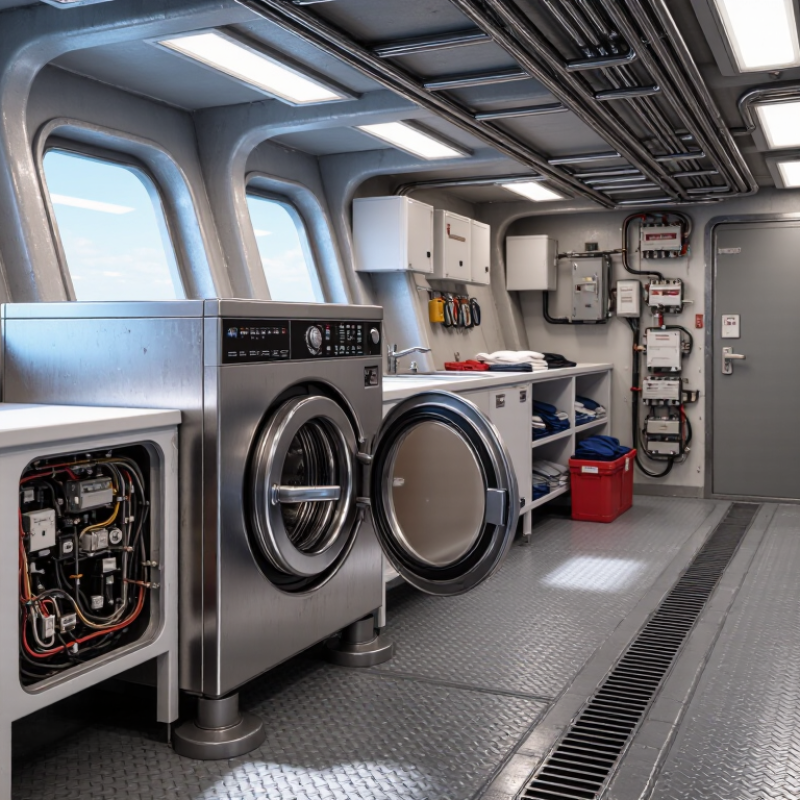
Define Marine Duty: IEC 60092 Electrical Standards and 50/60 Hz Power
A marine washing machine must match the vessel’s electrical system, not just its drum size. IEC 60092 sets requirements for shipboard electrical installations, including insulation, protection, earthing, vibration resistance, temperature, and electromagnetic compatibility. It is a series of standards, not a simple “marine certified” label. Ask suppliers for the exact IEC 60092 references and test evidence.
Frequency is equally important. Many vessels use 440 V, 60 Hz, while some operate at 380–415 V, 50 Hz. A 50 Hz motor connected to a 60 Hz supply may change speed, heating, and cycle performance. Electronic controls can also fail when voltage or frequency falls outside their rated range.
The IMO Fourth GHG Study 2020 estimated shipping produced 2.89% of global anthropogenic CO2 emissions in 2018. Efficient electrical equipment therefore matters, even in a laundry room. Small loads still accumulate.
Tips: Check the vessel’s single-phase voltage, frequency, breaker rating, starting current, and shore-power conditions. Request a nameplate photo, wiring diagram, IP rating, and IEC test documents. In my sourcing experience, suppliers often say “50/60 Hz compatible” without defining voltage limits. That is a warning sign. Confirm whether a transformer, frequency converter, or dedicated protection device is required. Also verify drainage, salt-air corrosion protection, door locking, and service access. The cheapest unit may create the most expensive installation mistake.
Set Capacity and Efficiency Targets Using IEC 60456 Test Methods
When sourcing a marine washing machine, capacity targets should reflect real onboard laundry routines, not showroom claims. IEC 60456 provides a repeatable framework for measuring cleaning performance, water use, energy use, and residual moisture. Use its reference program, controlled load, detergent dosage, and water conditions when comparing suppliers. Keep records.
A practical test begins with a defined load, such as 6 kilograms of cotton workwear and towels. Measure energy and water per cycle, then record cycle time and final moisture. A machine that saves water but leaves clothing heavily wet may increase drying demand. That trade-off matters onboard. Test several loads, because one perfect cycle proves very little.
IEC 60456 is designed for household appliances, so it cannot represent every marine condition. Vessel vibration, limited freshwater, unstable voltage, and compact installation spaces require additional checks. I would repeat the benchmark after transport vibration testing and under the vessel’s actual voltage range. Results may be less impressive. That is useful. Ask suppliers to submit raw data, test settings, and tolerance ranges, rather than polished averages. Set capacity from daily crew demand, peak laundry days, and available freshwater, while keeping efficiency targets tied to the same IEC-based method. Different test conditions make supplier comparisons unreliable.
Verify Corrosion Protection Through ISO 9227 Salt-Spray Testing
How to Choose a Marine Washing Machine for Global Sourcing?
Marine washing machines face salt air, splash water, condensation, and repeated handling. Corrosion protection should be verified, not assumed from polished metal or attractive product photos.
The NACE IMPACT study estimated global corrosion costs at 3.4% of worldwide economic output, or about US$2.5 trillion annually. That figure explains why a small rust mark can become a serious sourcing risk.
Ask the supplier for ISO 9227 salt-spray test records. The standard covers neutral salt spray, acetic acid salt spray, and copper-accelerated acetic acid salt spray. Select the method according to the machine’s materials and service environment.
Check the test solution, chamber temperature, specimen preparation, exposure hours, and inspection photographs. The report should identify coating thickness and any visible blistering, rust, or edge creep.
A test duration alone proves little. ISO 9227 does not set one universal pass-or-fail period for every appliance. The buyer must define acceptance criteria before testing.
For example, inspect cabinet seams, door hinges, drain fittings, fasteners, and concealed brackets separately.
These areas often fail before broad panels.
A practical sourcing file should include independent laboratory results, material certificates, coating records, and production samples. Salt spray is accelerated testing, not a perfect ocean simulation.
It may miss cyclic humidity, abrasion, and detergent exposure. I would request a follow-up cyclic corrosion test when the machine will operate near open water.
Some suppliers may resist this extra step. That resistance itself deserves attention.
Match Voltage, Frequency, IP Ratings, and Vessel Installation Limits
How to Choose a Marine Washing Machine for Global Sourcing?
Voltage and frequency must match the vessel’s electrical system. Common combinations include 220–240 volts at 50 hertz and 208–240 volts at 60 hertz. A mismatch can overheat motors, reduce cleaning performance, or cause repeated faults. Check the machine’s rated voltage, frequency, phase, and starting current. Do not rely on a product listing alone. Request the technical datasheet and wiring diagram. A qualified marine electrician should confirm compatibility before purchase.
The IP rating deserves careful attention. IP44 may resist splashing, but it does not make the machine corrosion-proof. Salt air can attack hinges, terminals, and exposed fasteners. Look for sealed controls, protected cable entries, and materials suited to humid service areas. Drainage also matters. A blocked outlet can leave water under the machine and create a slip hazard. Small details matter here.
Measure the installation space before selecting capacity. Record doorway width, service clearance, deck loading, drain height, and water pressure. Consider vibration during rough weather. Adjustable feet, secure anchoring, and flexible connections can reduce movement. I have seen efficient machines fail because technicians could not open the front panel fully. That mistake is easy to make. Vessel layouts change, and a catalog dimension may exclude hoses or door swing. Ask for a complete installation drawing, not only cabinet dimensions. Keep spare fuses, inlet screens, and basic seals available for remote operation.
Audit Global Suppliers for ISO 9001, CE, RoHS, MOQ, and Total Cost
How to Choose a Marine Washing Machine for Global Sourcing?
A marine washing machine must survive salt air, vibration, limited water, and irregular maintenance. Supplier audits should begin with ISO 9001, but certification alone proves little about this model. The ISO Survey 2022 recorded more than 1.2 million ISO 9001 certificates worldwide. That number shows broad adoption, not guaranteed factory discipline. Ask for the current certificate, audited site address, process records, calibration logs, and corrective-action evidence. Inspect one production unit, not only a polished showroom sample.
CE marking requires the manufacturer’s conformity assessment and technical documentation. It is not a quality award. For electrical parts, request a signed EU Declaration of Conformity and test reports covering applicable requirements. RoHS evidence should identify restricted substances, component suppliers, and test dates. Do not accept a generic PDF. It may be outdated. A traceable bill of materials is stronger.
MOQ can quietly damage a sourcing project. Compare the supplier’s minimum batch with vessel demand, spare-part needs, packaging space, and warranty stock. UNCTAD reports that over 80% of global merchandise trade moves by sea, so port delays and transport handling deserve real cost allowances. Build total cost from unit price, tooling, inspection, freight, duties, installation, energy use, repairs, and disposal. My checklist is imperfect. Exchange rates and corrosion failures can still surprise buyers. Use a pilot order with vibration, leakage, drainage, and salt-spray checks before committing to volume.
How to Choose a Marine Washing Machine for Global Sourcing
Use this chart as an audit-planning reference: ISO 9001 certification is commonly maintained through a three-year certification cycle, while EU CE and RoHS technical documentation and the EU Declaration of Conformity generally need to be retained for ten years after the product is placed on the market. MOQ and total cost are not fixed legal values, so compare supplier-specific quotations, shipping, installation, spare parts, maintenance, and compliance costs.