Best NFC Smart Door Lock Suppliers in China for Buyers
Choosing an NFC Smart Door Lock supplier in China requires more than comparing unit prices or polished catalogue photos. Buyers should examine the reader, credential options, firmware support, and the factory’s quality controls. A lock may look solid on a showroom door, yet behave differently after repeated use. Details matter.
Cybersecurity expert Bruce Schneier’s well-known reminder applies to connected access products: “Security is a process, not a product.” For buyers, that means asking how credentials are managed, how software updates are delivered, and what happens when a phone or card is lost. Request model-specific test reports, clear warranty terms, and written answers about NFC compatibility. Check whether the lock works with your intended cards, phones, and access platform. Do not assume every NFC device will be supported.
A credible supplier should explain its production process without hiding behind broad claims. Ask for a sample, inspect the latch and reader, and test repeated unlocks under realistic conditions. Review packaging, installation instructions, and after-sales response times. Small details matter: a confusing setup sheet can slow an entire project. Price still matters, of course. But choosing the lowest quote before checking support can create avoidable costs later. This guide compares suppliers through practical buyer criteria, including product range, customization, communication, and evidence of quality. Some answers may remain uncertain until a sample is tested. That is worth acknowledging.
Understanding NFC Smart Door Locks and How They Work
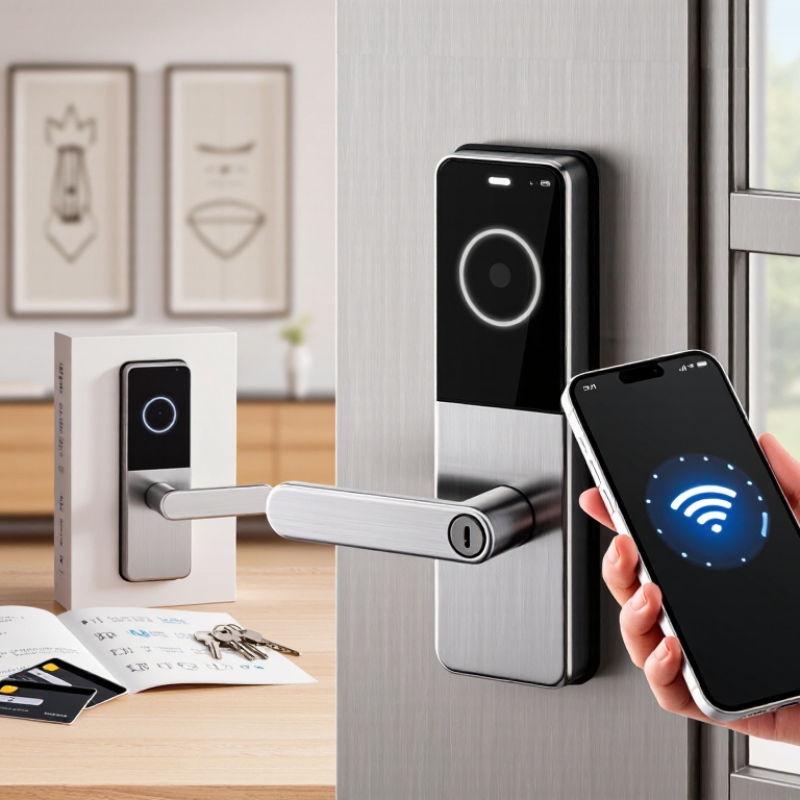
An NFC smart door lock reads a credential held very close to its reader, usually within a few centimeters. The credential may be an NFC card or a compatible phone. Very close range. When presented, it exchanges data with the lock’s reader. The lock’s controller checks whether that credential is authorized, then signals a small motor to retract the bolt. The process usually takes a moment.
The phone does not simply “open the door” by magic. Its NFC capability, software, and stored credential must work with the lock’s system. Compatibility can vary, so buyers should ask suppliers which phones and card types are supported. They should also check how credentials are added or removed, especially when a phone is lost or a staff member leaves. These details matter more than a polished product photo.
NFC access can be convenient at a busy entrance, where a user taps a card without searching for a key. Still, the lock depends on battery power and working hardware. Ask how it signals low battery and what backup access methods are available. Request test results for repeated unlocking, reader response, and operation after battery replacement. Specifications can look complete on paper; real installation conditions sometimes expose gaps. That part deserves a second look.
NFC Smart Door Locks: Standard Data Rates
NFC operates at 13.56 MHz and supports standard data rates of 106, 212, and 424 kbps. A smart lock uses NFC to exchange an access credential with a nearby device or card; these data rates describe the communication link, not the time needed to unlock the door.
Key Criteria for Comparing NFC Lock Suppliers in China
When comparing NFC smart door lock suppliers in China, look beyond the quoted unit price. Ask for NFC frequency, supported card types, read range, and encryption details. Request test records for repeated scans, low-battery operation, and failed access attempts. A polished sample is useful, but it cannot reveal how production batches perform.
Security deserves equal scrutiny. Verizon’s 2024 Data Breach Investigations Report found that 68% of breaches involved a non-malicious human element. That figure is not specific to door locks, but it highlights the value of clear setup procedures and controlled access permissions. Ask how firmware updates are delivered, how long support continues, and whether security findings are documented. NISTIR 8259A provides a useful baseline for evaluating IoT device security capabilities. One detail buyers sometimes overlook: confirm who owns the app, cloud service, and update process after delivery.
Tips: Compare written warranty terms, sample lead times, minimum order quantities, and spare-part availability. Ask for a small pilot batch before scaling. Test it in a real doorway, with the phone in hand and the battery nearly depleted. Supplier answers may sound convincing; verify the evidence.
Supplier Types and Manufacturing Capabilities to Consider
China-based NFC smart door lock suppliers usually fit three groups: trading companies, OEM/ODM providers, and integrated manufacturers. Trading companies can simplify sourcing across product lines, but buyers may have less visibility into factory processes. OEM/ODM suppliers can adjust housing, firmware, or packaging. Integrated manufacturers may control more steps, from metal machining and circuit-board assembly to final testing. A catalog alone proves little.
Ask what the supplier makes in-house and what it outsources. Request a sample, a component list, and documented inspection procedures. Check how NFC credentials are tested, how the reader performs with different card positions, and whether firmware updates are supported. Ask about battery warnings and mechanical testing, too. A supplier that shares clear test records is easier to assess, though paperwork cannot replace hands-on checks. Small inconsistencies matter.
Tips: Test samples with the cards and phones your project will actually use. Confirm the lock’s dimensions against the door, including backset and thickness. Ask for defect-handling steps and spare-part availability before placing a large order. One awkward point: sample units may be better finished than later production batches, so agree on repeat inspections and acceptance criteria.
How to Verify Product Quality, Certifications, and Security
When comparing NFC smart door lock suppliers in China, request a production sample, not just polished photos. Test the lock with the phones and NFC cards your customers actually use. Check read distance, response time, failed scans, and operation after repeated use. Ask for the exact model’s test reports and certification documents. Verify issuing bodies and report numbers independently; a certificate for a similar model proves little. Ask what each document covers. Small details matter.
Inspect the lock’s materials, wiring, and emergency power options. A loose connector or unclear backup procedure can turn a convenient lock into a service call. Request written details on data encryption, access permissions, event logs, and firmware updates. Ask how updates are delivered and whether access records can be protected from unauthorized changes. Good answers should be specific, not simply “secure.” No checklist catches everything. Compare supplier claims with sample results, and keep records of test conditions. I would also ask for a clear warranty process and spare-part availability. That part is easy to overlook. A supplier’s response to technical questions can reveal as much as its product sheet.
Comparing Pricing, Customization, and After-Sales Support
When comparing NFC smart door lock suppliers in China, look beyond the quoted unit price. Ask whether it includes the reader, batteries, mounting hardware, packaging, and firmware setup. A low quote can exclude small items that add up across a full order. Request pricing at several quantities, and check how shipping, sample fees, and replacement parts are handled. Get the details in writing.
Customization can cover card formats, finishes, app interfaces, language settings, and packaging. Not every change is equally simple. A new color may need little development, while a modified lock body could affect tooling, testing, and delivery time. Ask for a sample that matches the final specification, not just a similar model. Confirm the minimum order quantity and who pays for design changes. Small details matter.
After-sales support deserves the same scrutiny as price.Ask how quickly technical questions are answered, whether spare components are stocked, and what documentation comes with the lock. Clarify how firmware updates are tested and delivered. A supplier’s promise is useful, but a named contact and written response process are better. One awkward point: support may feel unnecessary until installation problems appear. Compare the actual service terms, not just reassuring sales language.