What Are the Best French Patio Doors in 2026?
Choosing the right patio doors affects more than a room’s appearance. The doors shape daylight, outdoor access, energy use, and the space available for furniture. For homeowners comparing French Doors Patio Doors in 2026, the best choice depends on the opening, local climate, budget, and daily habits—not just the product photo.
This guide examines practical details that can be easy to miss. Consider whether the panels swing inward or outward, and measure clearance around nearby tables, railings, and walkways. Check frame materials, glazing options, weather seals, hardware, and the threshold height. On a rainy or windy site, those details matter. Very much.
We’ll compare common styles and explain which features may suit different homes, while noting that product specifications and availability can change. Look for clear performance information, credible warranties, and installation guidance from qualified professionals. A well-made door can still disappoint if it is poorly sized or installed. That part is sometimes overlooked.
There is no universal winner. A compact room may benefit from a different configuration than a wide opening onto a garden. Even attractive finishes can require more upkeep than expected. Use the comparisons ahead to identify what fits your home, then confirm measurements and specifications before buying.
Define French Patio Doors by Swing Style, Panel Count, and Opening Type
What Are the Best French Patio Doors in 2026?
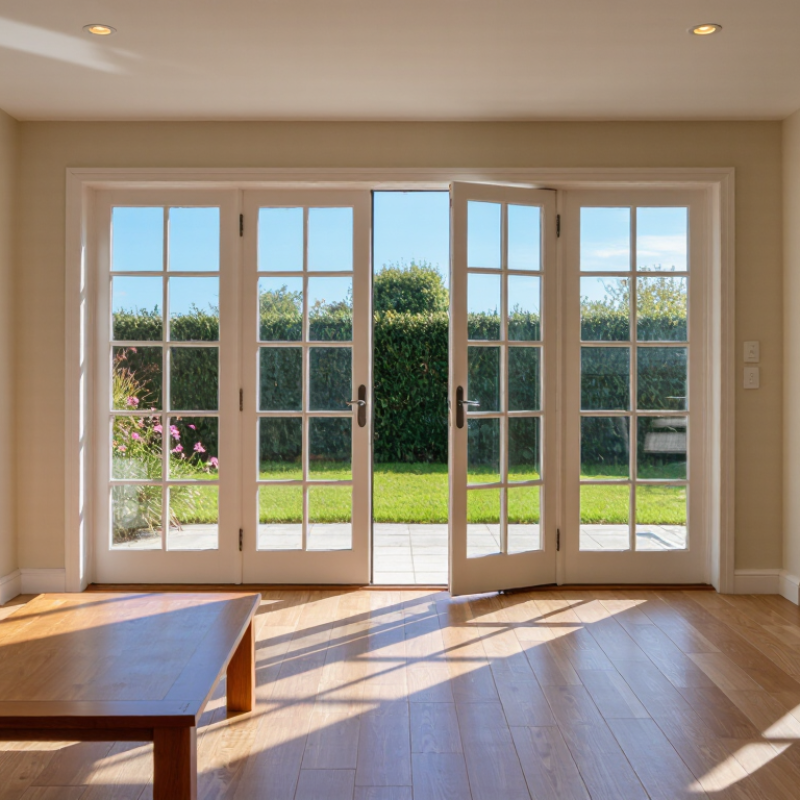
French patio doors are best understood by how they swing, how many panels they use, and which panels open. The familiar version has two hinged panels meeting in the middle. One or both may operate, depending on the configuration. Some models use a single hinged panel beside a fixed glass panel. That layout can suit a narrower wall opening.
Swing direction changes how the doorway feels in daily use. Inswing doors open into the room, so check that they will not strike a table or block a walkway. Outswing doors preserve indoor floor space, but need clear exterior space for their arc. A damp doormat or deep snow can complicate that choice. Details matter.
Panel count is not the same as the number of moving panels. A three-panel arrangement may have one active door and two fixed sections, while a paired design may open from the center. French-style patio doors can also describe sliding systems with broad glass panels, though they do not swing like traditional hinged doors. For a real comparison, measure the rough opening, note furniture and deck clearance, and confirm which panels operate. I have seen drawings look generous; the finished passage can feel tighter. Inspect the usable opening, not just the glass area.
Compare NFRC U-Factor, SHGC, Visible Transmittance, and Air-Leakage Ratings
What Are the Best French Patio Doors in 2026?
The best French patio doors depend on your climate, exposure, and installation—not appearance alone. Read the NFRC label before comparing quotes. Its U-factor measures heat flow; lower values generally mean better insulation. SHGC measures how much solar heat enters, while Visible Transmittance (VT) indicates how much daylight passes through. These values range from 0 to 1. A sunny south-facing room may benefit from a lower SHGC, while a shaded room may need more daylight. There is no single ideal combination.
The U.S. Department of Energy’s Energy Saver guidance estimates that windows account for 25–30% of residential heating and cooling energy use. That makes glass ratings worth checking. But they are not the whole story. ENERGY STAR window criteria set a maximum air leakage of 0.3 cubic feet per minute per square foot; compare this separately, since air leakage is not one of the four NFRC ratings discussed here. Lower leakage can help limit drafts around a closed door.
Look closely at the threshold, weatherstripping, and the gap where the frame meets the wall. A high-performing door can still feel drafty if installation is poor. Ask for the full performance label and tested air-leakage figure, not just a sales description such as “energy efficient.” One caveat: ratings cannot predict every home’s comfort, and real-world results depend on workmanship, shading, and how often the doors are opened.
Assess NAFS Performance Grades: R, LC, CW, and AW
What Are the Best French Patio Doors in 2026?
Assess NAFS Performance Grades: R, LC, CW, and AW
The best French patio door is not automatically the one with the highest NAFS class. R suits many one- and two-family homes; LC targets low-rise multifamily and light commercial buildings. CW is designed for more demanding commercial conditions, while AW addresses high-rise and other severe applications. These classes describe tested performance expectations, not a simple quality ranking. Check the product’s full performance grade and design-pressure rating against local wind exposure, building height, and installation details.
NAFS-22, the North American Fenestration Standard, sets performance requirements for windows and doors. A class letter alone does not tell you how well a door insulates. The U.S. Department of Energy estimates that heat gain and loss through windows account for 25–30% of residential heating and cooling energy use. Compare NFRC-certified U-factor and solar heat gain coefficient ratings alongside NAFS performance. A high structural rating can still leave a chilly draft if the frame, weather seals, or installation are poor.
Tips: Ask for the tested NAFS label, including class and performance grade, not just “impact-rated” or “heavy-duty” claims. Match ratings to your site’s wind conditions, then inspect the sill, multipoint locks, and weatherstripping. Small gaps matter. I’d also check how the door drains after rain; that detail is easy to overlook, even when the paperwork looks reassuring.
Evaluate Frame Materials, Low-E Glazing, Security, and Threshold Design
Choosing French patio doors in 2026 means balancing appearance with everyday performance. Vinyl frames are usually low-maintenance, while wood offers warmth but needs regular care. Fiberglass can resist swelling and temperature changes, though quality varies. Compare full-frame samples, not just showroom corners. Check how the frame feels and whether the finish suits your room’s light.
Low-E glazing can reduce heat transfer, but the right specification depends on climate, window orientation, and shading. A sunny west-facing opening may need different solar control from a shaded one. Ask for documented energy ratings, and check whether the glass package fits your local conditions. More layers are not automatically better. Clear views matter, too.
Security depends on the whole assembly: lock points, hinges, frame anchoring, and glass choice. Look for a rigid multi-point lock and hardware that operates without forcing. Test it in person. Threshold design deserves equal attention. A low, nearly flush sill is easier to cross, but it must still manage wind-driven rain and drainage. Ask how the installer will seal the sill and connect it to the floor. That detail is easy to overlook, and sometimes the neatest-looking option is not the most practical one.
What Are the Best French Patio Doors in 2026?
Frame material comparison: representative thermal conductivity
Lower thermal conductivity means less heat passes through the frame material itself. Approximate values shown are in W/(m·K); actual values vary by product, and a complete door’s insulation also depends on frame design, glazing, and installation. Compare whole-door NFRC ratings and Low-E glazing for climate-appropriate performance. For added security, consider reinforced frames and multi-point locks. On accessible routes, ADA standards limit thresholds to 1/2 inch, with specific beveling requirements for taller changes in level.
Match 2026 Door Options to Climate, Budget, Warranty, and Installation Needs
What Are the Best French Patio Doors in 2026?
The best French patio door depends on your weather, budget, and opening. In cold or windy areas, look for insulated glass, tight weather seals, and a frame suited to temperature swings. In humid or rainy climates, water management and durable finishes matter more than decorative details. A sunny room may need low-emissivity glass to reduce heat and fading. Small details count: check how the sill drains after rain.
Price the full project, not just the door. Removal, trim, flashing, and repairs to the opening can add significant cost. Compare warranties for glass, frame, hardware, and installation; coverage may differ, and exclusions can be easy to miss. Ask an installer to inspect the wall opening before you commit. I would not assume every “energy-efficient” label means the same performance. Request ratings and written scope.
Tips: Measure twice. Ask who handles flashing and cleanup. Get the warranty terms in writing, and confirm the installer has experience with your wall type. A low quote can still be a poor fit.