
Print Logo

Best China Industrial Automation Lens Manufacturers?

China’s industrial automation sector is expanding quickly, and optical components are becoming more critical. An Industrial Automation Lens must survive vibration, dust, heat, and continuous production cycles. It also needs precise imaging across changing distances and lighting conditions.

The International Federation of Robotics reported 276,288 industrial robot installations in China during 2023. This represented about 51% of global installations. That scale creates strong demand for machine-vision lenses in electronics, automotive, logistics, packaging, and battery manufacturing. MarketsandMarkets also identifies machine vision as a growing automation technology, supported by inspection, measurement, and robotic guidance applications.

The lens is the eye of automation.

Cognex founder Robert J. Shillman has described machine vision as “the eyes of automation.” His statement remains useful when comparing China’s leading manufacturers. A dependable supplier should offer low-distortion optics, stable mounts, broad focal-length options, and responsive technical support. Certifications matter, but practical testing matters more. A lens that performs well in a clean laboratory may struggle beside an oil mist, conveyor vibration, or reflective metal surface.

No ranking is perfect. Price tables rarely reveal coating durability, sample-testing quality, or replacement speed. Therefore, this guide compares Best China Industrial Automation Lens Manufacturers through product performance, engineering experience, export capability, customization, and customer reliability. Readers should still verify current specifications, warranty terms, and test results before purchasing.
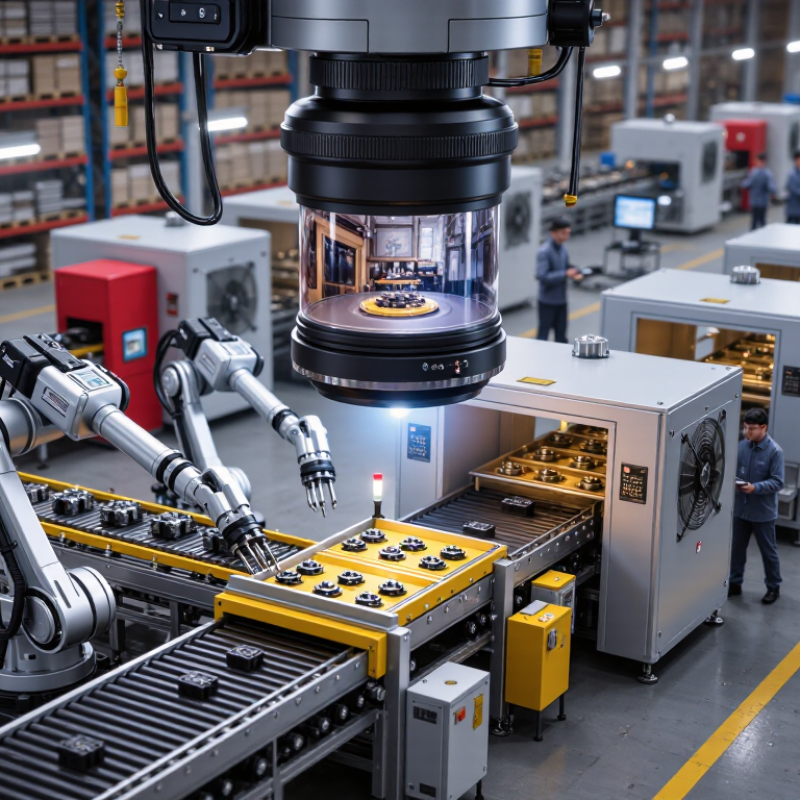
Best China Industrial Automation Lens Manufacturers?

What Are Industrial Automation Lenses and Why Do They Matter?

Industrial automation lenses are optical components used in cameras that inspect products, guide robots, and measure machine parts. They control how clearly a sensor sees edges, surfaces, codes, and small defects. In a production line, a poor lens can create blurred images, false alarms, or missed flaws. The problem may look like software failure, but the optics are often responsible.

When comparing Chinese industrial automation lens manufacturers, evaluate more than price. Check resolution, distortion, working distance, aperture stability, and compatibility with the camera sensor. Ask for test images taken under lighting similar to your factory. A metal surface may reveal glare that a catalog photograph hides. I have found that lens selection becomes easier when engineers measure the smallest defect before requesting samples. A perfect specification sheet is not enough. Real installation conditions can still expose weaknesses.

Tips: Confirm the required field of view and mounting thread. Test the lens at production speed, not only on a quiet workbench. Inspect thermal stability if the camera operates near ovens or motors. Keep sample records, including distance, lighting, and exposure settings. Do not assume the most expensive lens is automatically the best choice. A modest error in alignment can reduce image quality, and that detail is easy to overlook.

What Are Industrial Automation Lenses and Why Do They Matter?

Industrial automation lenses project a machine-vision scene onto a camera sensor. Focal length directly affects viewing angle: shorter lenses capture a wider area, while longer lenses provide a narrower view for inspecting distant or detailed targets. The chart shows the theoretical horizontal field of view for common focal lengths when paired with a 1/3-inch sensor with an approximately 6.4 mm active width. Values are calculated using the standard field-of-view formula and are intended for lens selection reference.

Key Criteria for Evaluating Chinese Automation Lens Manufacturers

Evaluating Chinese industrial automation lens manufacturers requires more than comparing quotations. Start with optical performance: focal length, distortion, resolution, aperture, wavelength range, and working distance. Request MTF charts and measured samples, not only catalog values. A production image should reveal sharp edges, stable contrast, and minimal glare under factory lighting.

Material selection matters. Check glass grade, coating durability, housing strength, sealing, and tolerance control. Ask how each batch is inspected and recorded. Reliable manufacturers should provide traceable inspection reports, calibration records, and clear acceptance standards. ISO certification can support confidence, but it does not replace process evidence. Factory audits also help. Look at cleanliness, assembly discipline, temperature control, and test equipment.

Communication is another practical test. Engineers should explain trade-offs in plain language and answer questions with data. Confirm prototype lead time, revision procedures, packaging, and after-sales support. Small details matter. Can they reproduce the same optical result after several batches? I have found that a low price may hide unstable tolerances or weak coating control. A checklist helps, but it can miss real production behavior. Request samples for vibration, temperature cycling, dust exposure, and continuous operation. Some evaluation methods may still be incomplete, especially when field lighting differs from laboratory conditions. Review those gaps openly before approving volume production.

Best China Industrial Automation Lens Manufacturers? - Key Criteria for Evaluating Chinese Automation Lens Manufacturers
Evaluation Dimension What to Verify Recommended Industry Benchmark Why It Matters in Automation Suggested Priority
Optical Format Compatibility Sensor format, image circle, mount type, flange distance, and compatibility with the intended camera. The lens image circle should fully cover the sensor format with a practical margin to prevent corner shading. Incorrect format matching can cause vignetting, reduced usable pixels, or mechanical incompatibility. High
Focal Length and Field of View Fixed focal length, working distance, object size, field of view, and camera resolution. Field-of-view calculations should be based on the actual sensor dimensions and working distance, not only the nominal focal length. A suitable field of view is essential for inspecting the complete part while maintaining sufficient detail. High
Resolution and MTF Performance Modulation Transfer Function data, center-to-corner sharpness, and performance at the required spatial frequency. Request MTF curves at the working aperture and confirm that performance meets the camera pixel pitch and inspection detail requirement. High nominal megapixel ratings do not guarantee usable resolution across the entire image field. High
Distortion Control TV distortion, geometric accuracy, calibration support, and consistency between production batches. For measurement applications, select low-distortion optics and validate distortion using a calibrated target under operating conditions. Distortion directly affects dimensional measurement, pattern matching, and robotic positioning accuracy. High
Aperture and Depth of Field Maximum aperture, working aperture range, iris type, depth of field, and light transmission. The usable aperture should provide adequate depth of field without unacceptable diffraction or loss of image contrast. Industrial parts may vary in height; insufficient depth of field can create inconsistent inspection results. High
Spectral and Coating Performance Operating wavelength, anti-reflection coating range, transmission, and suitability for visible or near-infrared illumination. Coating specifications should cover the actual illumination wavelength, commonly visible light or near-infrared bands used by the application. Proper coatings improve contrast, reduce flare, and help maintain stable exposure in machine-vision systems. High
Mechanical Stability Housing material, locking mechanism, focus and iris retention, vibration resistance, and mounting repeatability. Focus and aperture settings should remain stable during vibration, temperature changes, and repeated machine operation. Mechanical drift can lead to focus changes, exposure variation, and unreliable inspection over time. High
Environmental Protection Ingress protection options, operating temperature, humidity resistance, contamination control, and sealing design. For exposed installations, confirm the required protection level and temperature range from documented test or product data. Dust, oil mist, moisture, and thermal cycling can degrade image quality and shorten service life. Medium
Calibration and Measurement Support Distortion files, calibration data, optical drawings, tolerances, and sample inspection support. The supplier should provide dimensional drawings and application-specific optical data before final approval. Reliable documentation reduces integration time and supports traceable machine-vision measurements. High
Quality Management Incoming inspection, lens centering, coating inspection, final optical testing, traceability, and corrective-action procedures. Look for documented inspection records, batch traceability, and a repeatable final inspection process. Consistent optical performance is more important than the performance of a single approval sample. High
Customization Capability Special mounts, custom focal lengths, filters, protective windows, coatings, and mechanical modifications. Evaluate whether engineering changes can be documented, sampled, tested, and reproduced in volume. Customized optics may be necessary when standard lenses cannot meet space, wavelength, or performance constraints. Medium
Prototype and Production Lead Time Sample availability, tooling requirements, production capacity, change-control process, and delivery consistency. Confirm the sample-to-production schedule in writing and assess whether the supplier can support the forecasted volume. Stable delivery is critical for machine-building projects and continuous production lines. Medium
Application Engineering Support Optical selection assistance, field-of-view calculations, lighting coordination, installation guidance, and troubleshooting. Prefer suppliers able to review camera, lighting, working-distance, and environmental requirements together. Many vision problems result from system-level mismatches rather than from the lens specification alone. High
Total Cost of Ownership Purchase price, integration labor, replacement availability, warranty terms, calibration effort, and service life. Compare total installed cost and expected operating stability instead of evaluating unit price alone. A lower-cost lens may create higher expenses through rework, downtime, recalibration, or inconsistent inspection. Medium
Sample Validation Method Test target, lighting setup, camera settings, working distance, acceptance limits, and repeatability tests. Approve samples using the same camera, lighting, aperture, and production conditions planned for the final system. Application-specific testing provides more reliable evidence than catalog specifications alone. High

Leading China-Based Industrial Automation Lens Manufacturers

Best China Industrial Automation Lens Manufacturers?

Leading China-Based Industrial Automation Lens Manufacturers

China-based industrial automation lens manufacturers serve demanding applications in inspection, robotics, measurement, and factory monitoring. Their products commonly support C-mount cameras, fixed focal lengths, telecentric systems, and high-resolution sensors. A suitable lens must match the sensor size, working distance, field of view, and lighting arrangement. A small mismatch can create dark corners or blurred edges.

Experienced manufacturers usually provide optical drawings, MTF data, distortion figures, and coating specifications. These details help engineers compare performance beyond a product photograph. Strong suppliers also maintain inspection records for centering, resolution, and mechanical tolerances. Ask whether each batch receives traceable testing. That question often reveals the real production discipline.

Practical evaluation should include sample testing on the actual camera and lighting system. Check images at the center and corners, then inspect contrast around fine printed lines. Test the lens near the factory’s expected temperature range, too. Some suppliers offer customization for mounts, apertures, filters, or cable clearance, but lead times may change. Communication can also be imperfect when technical terms are translated. Clear drawings reduce that risk.

Not every low-cost lens is a poor choice. Not every premium quotation guarantees stable results. Engineers should review sample images, inspection documents, response speed, and after-sales support together. A supplier that openly discusses limitations may prove more reliable than one making flawless claims. Even experienced teams sometimes underestimate vibration or dust exposure. That mistake deserves attention before volume purchasing.

Comparing Lens Types, Specifications, and Manufacturing Capabilities

Best China Industrial Automation Lens Manufacturers?

Comparing Lens Types, Specifications, and Manufacturing Capabilities

Selecting an industrial automation lens starts with the inspection task, not the catalog. Fixed-focal lenses suit stable production lines and offer predictable imaging. Zoom lenses help during changeovers, but their distortion can vary across focal lengths. Telecentric lenses reduce measurement errors caused by object height changes. Line-scan lenses require careful matching with sensor size and conveyor speed. Small details matter.

During factory evaluations, I check working distance, sensor format, focal length, aperture, distortion, and MTF data. A 25 mm lens may appear suitable, yet its image circle can fail with a larger sensor. Lighting also changes the decision. Coaxial illumination often needs excellent field uniformity, while angled light exposes surface defects. Resolution should be tested on real parts, not only on charts.

Manufacturing capability deserves equal attention. Reliable suppliers should control grinding, polishing, centering, coating, assembly, and final inspection in documented steps. Ask for temperature testing, vibration results, coating durability, and inspection records. Custom lenses need optical simulation, prototype control, and repeatable alignment. Traceability is essential when several production batches serve one machine. I once underestimated mounting tolerance, and the lens passed bench testing but failed after installation. That mistake still shapes my acceptance checklist. Specification sheets can look complete. Practical verification is rarely perfect.

How to Select the Right Chinese Automation Lens Supplier

Selecting a Chinese automation lens supplier requires more than comparing catalog prices. In factory projects, lens performance affects inspection accuracy, cycle time, and maintenance costs. Define the application first: sensor size, working distance, field of view, wavelength, resolution, and lighting conditions. A supplier should explain these trade-offs clearly, not simply recommend the most expensive model. Ask for optical drawings, tolerance data, and test images from similar applications. Real evidence matters.

Request a small evaluation batch before approving volume production. Check edge sharpness, distortion, focus stability, coating consistency, and mechanical fit under actual lighting. Thermal cycling and vibration tests may reveal weaknesses that a clean showroom cannot. Review the supplier’s quality process, incoming inspection records, calibration methods, and batch traceability. Confirm how they handle nonconforming parts and engineering changes. Documentation should be precise and easy to verify.

Technical communication is equally important. Can the engineering team read your drawings, discuss mounting errors, and provide measurable corrective actions? Ask about lead times, spare units, packaging, export documents, and after-sales support. A factory visit or remote production audit can strengthen confidence, although neither guarantees perfect consistency. We have seen promising samples fail during long production runs. That possibility deserves attention. Select a supplier that reports limitations honestly and accepts controlled improvement instead of promising flawless results.