
Finding a dependable 12v 2 Amp Charger in China starts with matching the charger to your device, not choosing the lowest price. Check the required output voltage, current, connector size, polarity, and charging method. A plug that almost fits is still the wrong plug. So is an adapter with unsuitable polarity. These details can prevent avoidable returns and equipment damage.
Buyers can compare established electronics manufacturers, specialist power-supply suppliers, and business-to-business marketplaces. A supplier’s location alone does not prove product quality. Ask for a current specification sheet, clear product photos, and test documentation that matches the exact model. Confirm input voltage, cable length, plug options, warranty terms, and minimum order quantity in writing. If you are sourcing for a particular country, verify that the plug and applicable safety requirements suit that market. Request a sample before placing a large order, then check its label and performance with suitable equipment. This takes time. No shortcut is perfect.
This guide will explain how to assess Chinese suppliers, compare quotations, and spot claims that need closer review. Look for consistent answers and traceable business details, rather than polished listings alone. I would not treat a certificate image as proof without checking its scope and model number. Small suppliers can be responsive, though their documentation may be uneven. That is worth weighing carefully.
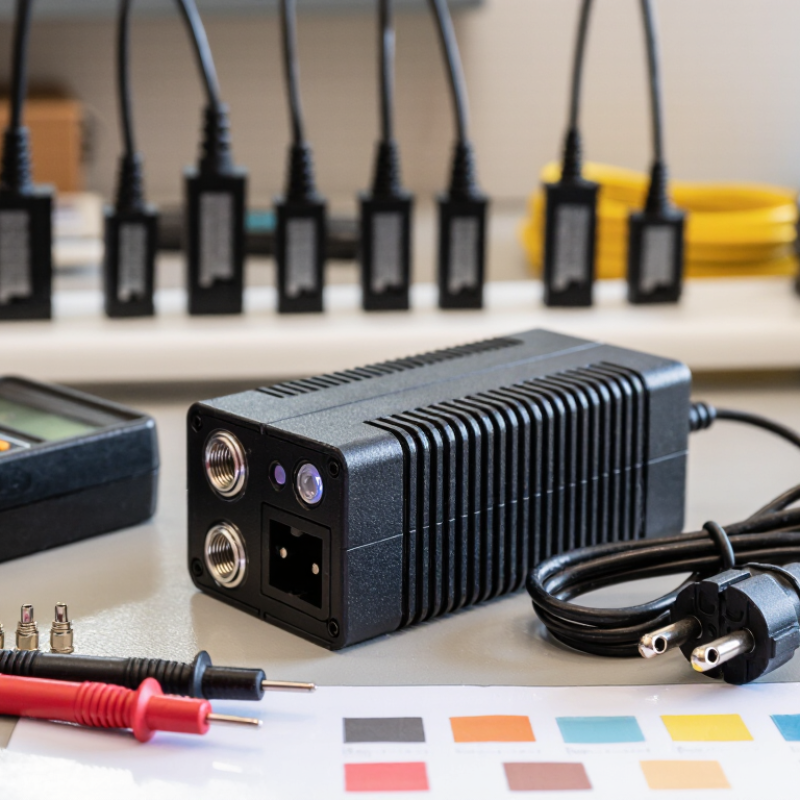
Where to Buy the Best 12V 2 Amp Charger in China?
When comparing suppliers in China, check the output label before comparing prices. A charger rated at 12 volts and 2 amps provides 24 watts: 12 V × 2 A = 24 W. Confirm these are the DC output figures, not the input rating printed nearby. Small labels can be easy to misread. Ask the seller for a clear product photo and a datasheet showing output voltage, current, connector, and polarity. A neat label helps, but it does not prove performance.
Tips: Request a sample and test it with a suitable load. Check that the output stays close to 12 V under use, and confirm the plug fits firmly. Match the polarity and your device’s stated power requirements. A 24 W figure alone cannot confirm compatibility.
For a dependable purchase, compare suppliers that answer technical questions clearly and provide consistent specifications across the listing, label, and datasheet. Ask whether the 2 A rating is continuous, since vague peak ratings can be misleading. Check the charger’s size and cable length too; a short lead may not reach a nearby outlet. If the seller cannot explain the rating, keep looking. Price matters, of course, but a cheaper unit is a poor bargain if its output is unstable. Even a careful check has limits, so verify the sample before ordering in quantity.
| Buying Option | What to Check | Useful Evidence | Best Suited For |
|---|---|---|---|
| Manufacturer’s official online store | Confirm that the listing identifies the exact adapter model and specifies a 12 V DC output rated for at least 2 A. | Product label image, model-specific datasheet, and a clearly stated return or warranty policy. | Buyers who want model documentation and a direct source. |
| Established online marketplace seller | Check the seller’s business details, product photographs, output specifications, and whether the listing is for a regulated power adapter. | Readable rating-label photos and written confirmation that the output is 12 V DC, 2 A, or higher. | Buyers comparing availability and delivery options across multiple sellers. |
| Local electronics or electrical-supply shop | Bring the device or its original adapter to match the connector, polarity, and required voltage. | Inspect the adapter label and ask to confirm connector fit and polarity before purchase. | Buyers who need to check the plug in person or want local assistance. |
| Electronics component market or distributor | Ask for the full electrical rating and documentation; do not rely on “12 V” alone. | Datasheet or manufacturer specification showing output voltage, current, and applicable safety information. | Technical buyers, repair work, or purchases requiring documentation. |
| Required output power | 12 V × 2 A = 24 W. The adapter’s rated output must provide at least 24 W at 12 V. | Check the output line on the adapter label, typically shown as “Output: 12 V DC, 2 A.” | Every buyer verifying that the charger meets the stated 12 V, 2 A requirement. |
| Input and plug compatibility | Check that the adapter’s AC input rating is suitable for the local mains supply and that its AC plug fits the intended socket. | Read the input-voltage and frequency range printed on the adapter; China’s nominal household supply is 220 V, 50 Hz. | Buyers using the adapter in China or taking it to another country. |
| Connector and polarity match | Match the plug type and dimensions, and confirm center-positive or center-negative polarity as required by the device. | Device manual, original adapter label, or polarity diagram. These details are device-specific. | Buyers replacing an adapter with a barrel connector or another non-USB plug. |
| USB-C or USB-powered option | A USB-C power source must support the voltage and current required by the device; a 12 V output is not guaranteed by every USB-C charger. | Check the charger’s listed output profiles and confirm that the device and cable support the required power arrangement. | Buyers whose device explicitly supports USB-C power delivery at 12 V. |
Before buying: Match voltage, connector, and polarity to the device. A higher current rating can be acceptable when the voltage and other compatibility requirements match, but the device determines the required voltage and connector.